Summary
Caroline and Grace Bell are orphaned sisters from Australia who come to England in the 1950s. Grace marries Christian Thrale, a civil servant, and settles into a comfortable, diminishing life. Caro, the harder and more intelligent of the two, is loved from their first meeting by Ted Tice, a young astronomer of unshakable decency, and chooses instead the playwright Paul Ivory. Ted goes on loving her for thirty years. That is the visible plot, and Hazzard follows it from postwar England to New York across a novel of some 340 pages.
The book is famous for how it is told. Hazzard writes in a distanced, authoritative narrative voice of a kind the critic Michael Gorra has said would have seemed old fashioned even in 1980, with characters firmly rooted in social circumstance, and then undercuts that classic form with shifting perspectives and a habit of telling you things sideways. The last pages are so elliptical, Gorra admitted, that on his first reading he missed them entirely, and his advice stands: pay attention to the most inconsequential details, and be prepared to read it again. It is a book that all but asks to be read twice.
Its social landscape, Gorra wrote, will be familiar to any reader of Lessing or Murdoch or Drabble, and yet it is not an English novel; Hazzard has the keenest of eyes for the nuances of class and nothing of her own at stake in getting them down. That outsider's coolness, together with what he called an eye like an awl and a willingness to reach for grandeur, is the pleasure of the book. Best for patient readers who like their love stories severe, and who do not mind being tested.
Historical Context & Significance
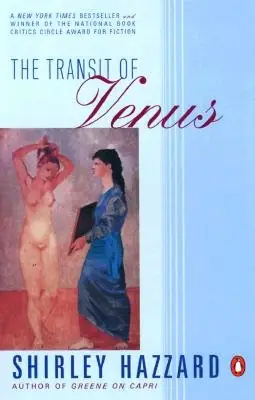
The Transit of Venus won the National Book Critics Circle Award for Fiction for 1980, presented in early 1981, over E. L. Doctorow's Loon Lake, Anne Tyler's Morgan's Passing, Walker Percy's The Second Coming and William Maxwell's So Long, See You Tomorrow, which went on to be a Pulitzer finalist that spring. Viking published it in 1980; it was Hazzard's third novel and, in the Guardian's word, her breakthrough. Hazzard was born in Sydney in 1931, left Australia young with her diplomat father, typed for a decade at the United Nations Secretariat in New York, and married the Flaubert scholar Francis Steegmuller in 1963; the novel qualified for this American prize by its American publication, and its author, Australian born, also held American citizenship.
Hazzard published no novel for another 23 years. The Great Fire (2003) won the National Book Award for Fiction, the Miles Franklin Award and the William Dean Howells Medal. She died in Manhattan in December 2016, aged 85. The Transit of Venus is included in The Australian Collection of the country's greatest books, and the Guardian placed it 53rd in its 2026 list of the best novels of all time.
Where to get it
We may earn a commission if you buy through these links, at no extra cost to you.
Opens WorldCat, a catalogue of library holdings run by the nonprofit OCLC. We do not ask for or receive your location.