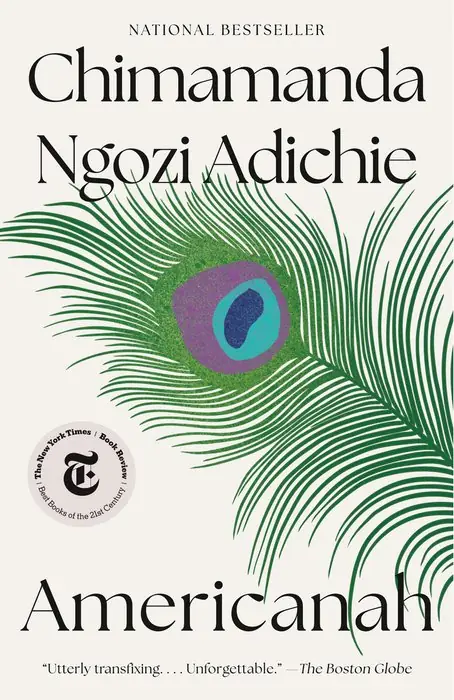
Summary
Ifemelu and Obinze fall in love as teenagers at secondary school in Lagos under the military dictatorship of the 1990s. Ifemelu leaves for university in the United States, where she discovers for the first time what it means to be Black, or as her blog later has it, "when you make the choice to come to America, you become black"; her Aunty Uju, a doctor who struggles to requalify in New York, tells her that all of them look alike to white people. Obinze means to follow, but after September 11 he is refused an American visa. He goes to London instead, delivers refrigerators, overstays, and is eventually deported back to Nigeria, where he becomes a wealthy property developer and marries a woman named Kosi whom he does not love.
Adichie frames the novel in a hair braiding salon in Trenton, New Jersey, where Ifemelu, now holding a fellowship at Princeton, sits for hours having her hair done and decides to go home after thirteen years. By then she has been through hard, humiliating jobs, a rich white boyfriend and an African American professor at Yale, and has made her name with a blog called Raceteenth or Various Observations About American Blacks (Those Formerly Known as Negroes) by a Non-American Black. Whole entries are dropped into the narrative, and their tartness is a large part of the book's pleasure. Back in Lagos she finds a city of new money and returnees who call themselves Nigerpolitans, and finds Obinze. The last part has the two of them in Lagos weighing whether to begin again, and the novel's final words are Ifemelu's to Obinze: "Come in."
At nearly five hundred pages this is a big, talkative, sociable novel, and a love story first. It is also very funny about hair, accents, liberal dinner parties and the small print of race in America and Britain. Mike Peed in the New York Times said it "holds the discomfiting realities of our times fearlessly before us"; Emily Raboteau in the Washington Post praised its "ruthless honesty"; Kirkus thought it soapy in spots "but a fine adult love story." It suits readers who want a novel of ideas that never stops being a page turner.
Historical Context & Significance
Americanah won the National Book Critics Circle Award for Fiction for 2013, over Alice McDermott's Someone, Javier Marías's The Infatuations, Ruth Ozeki's A Tale for the Time Being and Donna Tartt's The Goldfinch. In Britain it was shortlisted for the 2014 Baileys Women's Prize for Fiction. The New York Times Book Review named it one of the ten best books of 2013, and in 2024 the Times placed it twenty seventh in its list of the hundred best books of the century so far. By 2015 it had sold more than half a million copies in the United States, and in 2017 New York City chose it for its One Book, One New York program.
Adichie, born in Enugu, Nigeria, in 1977, had already won the Orange Prize for Half of a Yellow Sun in 2007, which was itself an NBCC finalist for 2006, and a MacArthur fellowship in 2008. HBO Max ordered a ten episode adaptation in September 2019, with Lupita Nyong'o starring and Danai Gurira as showrunner, and canceled it in October 2020 over scheduling. Adichie's next novel, Dream Count, appeared in 2025.
Where to get it
We may earn a commission if you buy through these links, at no extra cost to you.
Opens WorldCat, a catalogue of library holdings run by the nonprofit OCLC. We do not ask for or receive your location.