Summary
The Blue Flower opens amid the confusions of washday in a noble Saxon household in the 1790s, and it never raises its voice above that domestic pitch while telling one of the strangest love stories in European literature. Fritz von Hardenberg, who will become the poet Novalis, is twenty two, a student of Fichte and Schiller at Jena, Leipzig, and Wittenberg, and the son of a pious, hard pressed father who directs the Saxon salt mines and has had to sell estates and move the family to a modest town house. In 1794 Fritz sees Sophie von Kühn standing at a window. She is twelve. Something happened to me, he says, and he decides on the spot that she is his wisdom and his future wife. Sophie is plain, barely educated, and beneath the Hardenbergs socially, and Fitzgerald is very funny about the family's bewilderment: one brother is repelled to find that illness has left her bald, while the youngest, the boy they call the Bernhard, grasps something about Fritz's devotion that the adults cannot. His father, unnerved by the French Revolution, allows the engagement a year later. Then Sophie falls ill with consumption and dies a few days after her fifteenth birthday.
The title comes from a story Fritz is writing, in which a young man longs for a blue flower he cannot stop imagining. He reads the draft aloud and asks his listeners what the flower means, and the novel refuses to answer for him. Fitzgerald ends by following the family past the story's edge: the Bernhard drowned young, and Fritz, engaged again, wished for death and died of the same disease before he was thirty.
The book is about 225 pages, and Frank Kermode called its main narrative fragmentary and rather distanced, its allusions to philosophy, medicine, and agriculture unobtrusively certain, and its design something for the reader to make or discern. Kirkus found it touching, funny, and unflinchingly tragic, and Michael Hofmann in the New York Times called it a quite astonishing book. It rewards slow reading and a second go, and it suits anyone who likes a historical novel that trusts them to do some of the work.
Historical Context & Significance
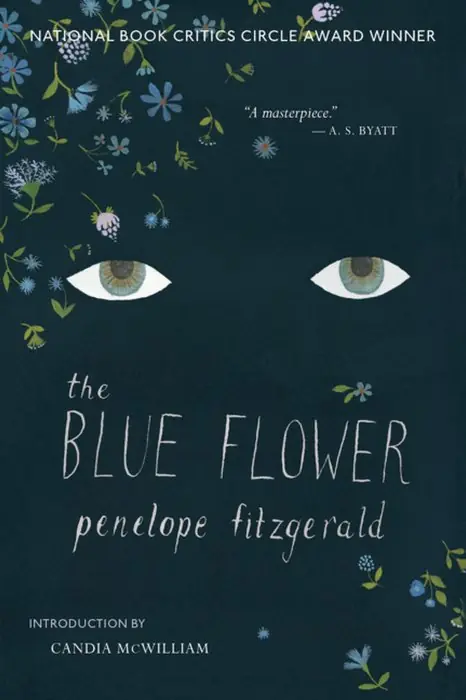
The Blue Flower won the National Book Critics Circle Award for Fiction for 1997, presented the following year, over Don DeLillo's Underworld, Charles Frazier's Cold Mountain, Andrei Makine's Dreams of My Russian Summers, and Philip Roth's American Pastoral, a formidable field. It was an unusual winner: an English novel first published by Flamingo in 1995, which reached America in April 1997 as the first title Houghton Mifflin issued under its new Mariner paperback imprint. Fitzgerald, born in 1916, had not published a book until she was fifty eight and had won the 1979 Booker Prize for Offshore, with three further shortlistings; The Blue Flower was her ninth novel and her last. She died on April 28, 2000, at eighty three.
Frank Kermode later called it the finest work of this extraordinarily gifted novelist, A. S. Byatt named Fitzgerald Jane Austen's nearest heir for precision and invention, the Observer listed it among the ten best historical novels in 2012, and Hermione Lee's 2013 biography of Fitzgerald won the James Tait Black Memorial Prize.
Where to get it
We may earn a commission if you buy through these links, at no extra cost to you.
Opens WorldCat, a catalogue of library holdings run by the nonprofit OCLC. We do not ask for or receive your location.