Summary
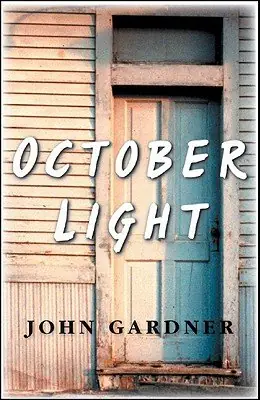
James Page is an old Vermont farmer, miserly, stooped and rock poor, working a hill place on Prospect Mountain. His sister Sally, eighty, has moved in with him and brought her television. James takes a twelve gauge shotgun to the set. Three weeks later, drunk on whiskey, he chases her upstairs with a fireplace log and locks her in her bedroom; she bolts the door from her side, goes on strike and lives on apples from the attic; and the novel settles in for a siege between two people who cannot bend, each certain the other stands for everything wrong with the country. That is the whole plot, and Gardner makes more than 400 pages of it, because the standoff is a way of arguing about principle, stubbornness and what a life is owed.
Inside the siege sits a second book. Sally passes the time with a paperback, a comic blockbuster about marijuana smugglers, and Gardner prints long stretches of it, so the reader reads the trash alongside her. It is there as a counterpoint to the moral seriousness of the main story, a novel about nothing set against a novel about everything, and readers have never agreed on whether the device earns its space. Kirkus, reviewing it in 1976, found the inner novel merely skimmable while calling the whole a serious comedy, a tragical comical historical pastoral farce, and praised Gardner's hoppingly electric powers even as it judged the book adrift in its riches, with unconvincing mouthpieces for its arguments.
That is a fair warning of what reading it is like. The Vermont chapters, with their godforsaken October moods, are dense, talky and often beautiful; the smuggler chapters are deliberately cheap; and the whole runs long. It suits readers who like a novel that argues with itself, who have patience for a farmer's rages and an old woman's pride laid out at length, and who are curious about the writer who, two years later, would pass judgment on the whole of American fiction.
Historical Context & Significance
October Light won the National Book Critics Circle Award for Fiction for 1976, presented in early 1977. The finalists that year were Renata Adler's Speedboat, Vladimir Nabokov's Details of a Sunset and Other Stories, Cynthia Ozick's Bloodshed and Three Novellas and Richard Yates's The Easter Parade. Knopf published it in December 1976, when Gardner was already well known for Grendel (1971), The Sunlight Dialogues (1972) and Nickel Mountain (1973).
The prize marked the peak of his standing. In 1978 he published On Moral Fiction, a polemic that judged living contemporaries including John Updike and John Barth and found them wanting; it put him on The Dick Cavett Show and on the cover of The New York Times Magazine, and it cost him friends among writers and reviewers. Gore Vidal, in The New York Review of Books in 1985, called him the late apostle to the lowbrows, a sort of Christian evangelical who saw Heaven as a paradigmatic American university. Gardner, born in Batavia, New York, in 1933, taught fiction all his adult life, and Raymond Carver was among his students at Chico State. He died in a motorcycle accident in Pennsylvania in September 1982, aged 49. New Directions returned October Light to print in 2005.
Where to get it
We may earn a commission if you buy through these links, at no extra cost to you.
Opens WorldCat, a catalogue of library holdings run by the nonprofit OCLC. We do not ask for or receive your location.