Summary
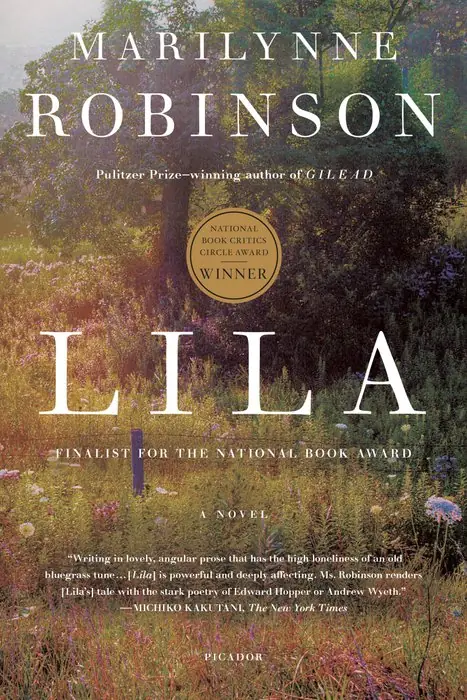
Lila is the third of Marilynne Robinson's novels set in the small Iowa town of Gilead, after Gilead (2004) and Home (2008), and it tells the story of the young wife whom the old minister John Ames married late and never fully explained. As a small child, neglected and left out on a stoop in the cold, Lila is carried off by a drifter named Doll, who raises her on the road through the Depression among migrant field workers. Their own bad times, Lila remembers, began when the mule died, two years or so before everyone else started getting poorer. She survives on what can be scavenged, cattails and pine sap included, spends a stretch in a St. Louis house she is ashamed of, and finally walks into an abandoned shack outside Gilead, meaning to be left alone.
A rainstorm drives her into Ames's church. The courtship that follows, between an elderly widower and a woman who cannot read well and trusts no one, is the heart of the book, and Publishers Weekly predicted it would "endure as a classic set piece of character revelation." They marry. Lila reads Ezekiel and Job at his kitchen table, asks him what the Calvinism he preaches means for people like Doll, whom it seems to condemn, and her questions unsettle him more than any parishioner's. The novel closes with the birth of their son, the boy to whom Gilead was addressed.
Robinson tells it in a close third person that moves in and out of Lila's memory without warning, and readers who want events in order should know the book asks for patience. What it gives back is prose of unusual plainness and beauty. Sarah Churchwell in the Guardian found "glorious prose, subtle wisdom and a darkly numinous atmosphere"; Leslie Jamison in the Atlantic called it "brilliant and deeply affecting"; Kirkus said fans "will wish the book were longer." It stands on its own, but it is richer read after Gilead.
Historical Context & Significance
Lila won the National Book Critics Circle Award for Fiction for 2014, presented on March 12, 2015 at the New School in New York. The citation, by board member Jane Ciabattari, said that "no one writes so simply yet profoundly of our yearnings and struggles, our troubling doubts and grateful affirmations of the good when we encounter it at last." The finalists were Rabih Alameddine's An Unnecessary Woman, Marlon James's A Brief History of Seven Killings, Lily King's Euphoria and Chang-rae Lee's On Such a Full Sea. Lila had also been a finalist for the 2014 National Book Award, won by Phil Klay's Redeployment, and in 2015 it was longlisted for the Man Booker Prize.
It was Robinson's second NBCC fiction award. Gilead had won the prize for 2004 and then the 2005 Pulitzer, and Home took the Orange Prize in 2009. Robinson, born in Sandpoint, Idaho, in 1943, taught at the Iowa Writers' Workshop from 1991 until her retirement in 2016. A fourth Gilead novel, Jack, followed in 2020.
Where to get it
We may earn a commission if you buy through these links, at no extra cost to you.
Opens WorldCat, a catalogue of library holdings run by the nonprofit OCLC. We do not ask for or receive your location.