Summary
Reyna is a tattooed white single mother in Harlem with a four year old son, Oliver, and a boyfriend, Boyd, who is serving three months on Rikers Island for selling marijuana. She visits him faithfully and their bond deepens, and when he gets out he draws her into a scheme with his friends: driving cheap cigarettes up from Virginia to sell untaxed in New York, a run that would breach his probation if it went wrong. Reyna, thinking of her child, pulls out of a trip at the last moment. Her absence sets off a chain of consequences, a wreck on the road among them, that reaches people she will never meet.
That is the spine of Joan Silber's novel, and around it she builds what the NBCC citation, written by fiction chair Tom Beer, called "a tightly woven collection of linked stories," eight chapters in three parts that move between the 1970s and 2012. Reyna's aunt Kiki, who lives in the East Village, once married a Turkish rug seller turned farmer and spent years in Turkey; her chapters bring in three German tourists who smuggle antiquities and a rug that travels down the decades. A truck driver survives a crash and takes stock of his brushes with death. Other chapters go to Richmond, Virginia, and to Berlin. Every character is trying, in the title's plain word, to improve their lot, and Silber is interested in what chance does to those plans.
At 227 pages of text it is short, and the prose, as Beer put it, is "colloquial and knowing and seemingly effortless." Kirkus called it a "winner," praising "the bumpy weave of its unpredictable story" and "sharply turned yet refreshingly unmannered prose." Publishers Weekly was cooler, finding some subplots too thin to make a fully cohesive ensemble. Readers who like the linked story form of Elizabeth Strout, or of Alice Munro, to whom the Washington Post compared Silber, will feel at home; those who want one plot followed to its end should know the book keeps changing hands.
Historical Context & Significance
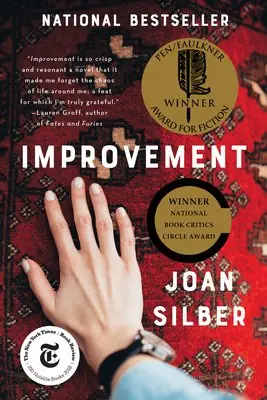
Improvement won the National Book Critics Circle Award for Fiction for 2017, announced on March 15, 2018. Fiction committee chair Tom Beer's citation, which had first run on the NBCC's blog a month before the ceremony, placed Silber among writers who "ply their trade more quietly," relying on "subtle language and profound insight into human nature, making art of everyday lives," and said there was "not a wasted word in all of the novel's 227 pages, which nevertheless contain multitudes." The finalists were Mohsin Hamid's Exit West, Alice McDermott's The Ninth Hour, Arundhati Roy's The Ministry of Utmost Happiness and Jesmyn Ward's Sing, Unburied, Sing, which had already won the National Book Award. Improvement then also won the 2018 PEN/Faulkner Award for Fiction.
The double win came late in a long, quiet career. Silber, born in 1945 and raised in Millburn, New Jersey, published her first novel, Household Words, in 1980, and Improvement was her eighth work of fiction, from the independent press Counterpoint. Nick Hornby, writing in the Believer, called it "a major work of literature." She has since published Secrets of Happiness (2021) and Mercy (2025) and has taught at Sarah Lawrence College.
Where to get it
We may earn a commission if you buy through these links, at no extra cost to you.
Opens WorldCat, a catalogue of library holdings run by the nonprofit OCLC. We do not ask for or receive your location.