Summary
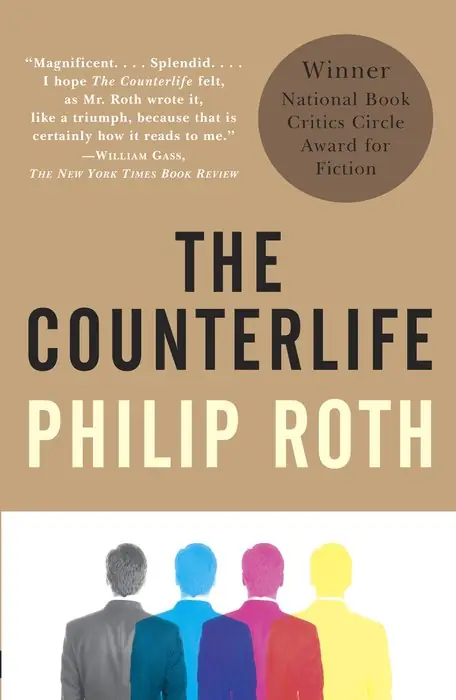
The Counterlife is five novels about the same two brothers, and they cancel one another out. In Basel, Henry Zuckerman, a suburban dentist, has a heart condition whose medication has made him impotent; rather than accept it he chooses risky heart surgery and dies on the table. His brother, the novelist Nathan Zuckerman, drafts a eulogy he cannot deliver and listens to Henry's widow Carol tell the mourners her husband did it for love of her. In Judea, Henry has survived the operation and, instead of going home, has vanished into a West Bank settlement run by a charismatic leader; Carol sends Nathan to fetch him, and Nathan comes back alone, harangued as a traitor to the Jews. In Aloft, on the flight home, a deranged fan named Jimmy produces a gun and a grenade, and Nathan is arrested beside him and humiliated to find the security men have never heard of him.
Then the deck is reshuffled. In Gloucestershire it is Nathan who has the heart condition and the impotence, Nathan who falls for Maria, the married Englishwoman upstairs, and Nathan who dies on the operating table hoping to become a family man in England. Henry, after the funeral, finds the manuscript of the very book we are reading and dumps the chapters that use him in a garbage bin on the New Jersey Turnpike. In Christendom, Nathan is alive and married to Maria, and living in England among her politely antisemitic family; a slight in a restaurant sets off a quarrel, and the novel ends in letters: Maria resigning from the marriage and from the book, objecting to being written, and Nathan replying that there is no you and no me, only the performances, the counterlives, we invent for ourselves and one another.
It is the fourth full length Zuckerman novel, 324 pages, and the one where Roth's usual subjects, sex, Jewishness, Israel, England, the family, are rebuilt as a hall of mirrors. Kirkus called it his most virtuoso effort yet and described its structure as discontinuous pleating. It is demanding, very funny in the Judea section, and best for readers who enjoy watching a novelist take his own machinery apart.
Historical Context & Significance
The Counterlife won the National Book Critics Circle Award for Fiction for 1987, presented in early 1988, over Toni Morrison's Beloved, Tom Wolfe's The Bonfire of the Vanities, Wallace Stegner's Crossing to Safety and Jane Smiley's The Age of Grief. Beloved won the Pulitzer Prize that spring, and the critics' preference for Roth's puzzle box over Morrison's novel has been argued about ever since. The book was also a finalist for the 1987 National Book Award, which went to Larry Heinemann's Paco's Story. Farrar, Straus and Giroux's first edition is dated 1986, but its reviews ran from the last days of that December through the first months of 1987.
The novel's reputation has climbed steadily among writers. Harold Bloom called it an astonishing book in his 1991 Paris Review interview; Martin Amis described it in 2012 as a masterpiece of postmodern fiction, a really very impressively intricate book; and James Wood, in The Guardian, called it perhaps his greatest novel. It closed the first run of the Zuckerman books, after The Ghost Writer, Zuckerman Unbound, The Anatomy Lesson and The Prague Orgy, and a decade later Zuckerman returned as the narrator of American Pastoral, I Married a Communist and The Human Stain. Vintage International keeps it in paperback.
Where to get it
We may earn a commission if you buy through these links, at no extra cost to you.
Opens WorldCat, a catalogue of library holdings run by the nonprofit OCLC. We do not ask for or receive your location.