Summary
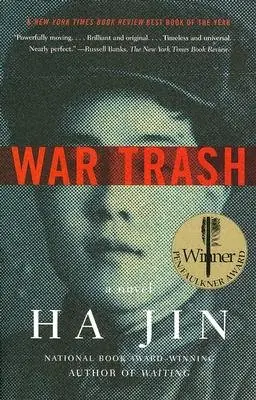
War Trash is Ha Jin's novel of the Korean War, published by Pantheon in October 2004 and written as the memoir of Yu Yuan, an old man visiting his son's family in the United States who sets down his story in English for his American grandchildren. As a young man Yu was a cadet at the Huangpu Military Academy, and he goes to Korea as a junior officer in the Chinese army, crossing the Yalu in March 1951. Taken prisoner by United Nations forces, he passes through camps at Pusan, on Geoje Island and on Cheju Island, and his English, rare among the prisoners, makes him an interpreter who deals with the Americans on behalf of the men.
The camps split between Communists and Nationalists over a single question: whether to go home to mainland China or on to Taiwan. Yu is no Communist, but he wants to return to his mother and his fiancée, Julan, and for that the Nationalist prisoners hold him down and tattoo an anti-Communist slogan on his body. He moves over to the Communist side and plays a part in the kidnapping of General Bell, the camp commandant, an episode drawn from the real seizure of General Francis T. Dodd. When he finally goes home, his mother is dead, Julan has left him, and as a man who surrendered he is marked for life as disloyal, one of the "war trash" of the title. He becomes a teacher, marries and raises children, and by old age the slogan on his belly has been cut down, some of its letters removed, into an insult aimed at the United States.
Ha Jin drew on his own years in the People's Liberation Army and on books, records, oral histories and photographs. The telling is plain and steady, closer to testimony than drama; Kirkus praised its "usual understatement and clarity," and the scholar Timothy C. Wong noted its "rather spare prose." It is long, a little under four hundred pages, and the middle stretches of camp politics can feel airless on purpose. Readers who want to understand how ordinary soldiers were ground between two ideologies, and what it cost them afterward, will find few novels that show it this patiently.
Historical Context & Significance
War Trash won the PEN/Faulkner Award for Fiction in 2005, Ha Jin's second after Waiting in 2000, and at the time it put him beside Philip Roth and John Edgar Wideman as the prize's only two time winners; E. L. Doctorow joined them the following year. The judge Herbert Gold summed up its subject as "The sense of what it was like for Chinese prisoners of war, imprisoned by Americans, during the Korean War," and the judge David Anthony Durham praised the reach of a story that runs from the Korean War all the way to "the contemporary America of The Simpsons." The finalists were Jerome Charyn's The Green Lantern, Edwidge Danticat's The Dew Breaker, Marilynne Robinson's Gilead and Steve Yarbrough's Prisoners of War.
The novel was also a finalist for the 2005 Pulitzer Prize for Fiction, which went to Gilead. It was his first book set outside China; he called it "a transition," and his next novel, A Free Life (2007), followed Chinese immigrants in America.
Where to get it
We may earn a commission if you buy through these links, at no extra cost to you.
Opens WorldCat, a catalogue of library holdings run by the nonprofit OCLC. We do not ask for or receive your location.