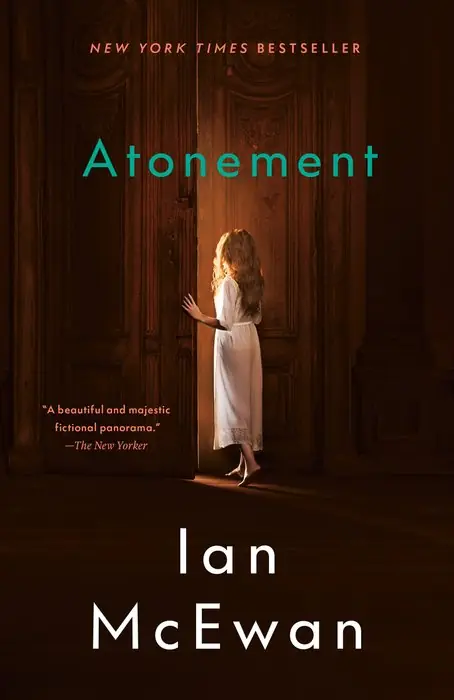
Summary
On a hot day in 1935 at the Tallis family's country house, thirteen year old Briony, who writes plays and wants to be a novelist, watches from a window as her older sister Cecilia strips to her underwear and climbs into the fountain in front of Robbie Turner, the housekeeper's son. Later that day Robbie asks Briony to carry a note to Cecilia and gives her the wrong draft, an obscene one he meant to throw away; she reads it. That evening she walks in on Robbie and Cecilia making love in the library and takes it for an attack. And that night, when the twin cousins run away and the house empties to search for them, Briony finds her cousin Lola being raped in the dark, cannot see the man's face, and tells the police she saw Robbie. Robbie goes to prison. The reader has seen enough to know it was Paul Marshall, the rich friend of Briony's brother Leon, who came to dinner with a scratched face.
Part Two follows Robbie, released early to enlist, through the retreat to Dunkirk in 1940 with a wound going septic, holding on to Cecilia's letters and to the one brief meeting they have had since. Part Three is Briony at eighteen, who has refused her Cambridge place to train as a nurse in London and understands at last what she did. She attends Lola's wedding to Marshall and says nothing, then goes to Cecilia's flat, finds Robbie there, and promises to recant.
Then the coda, London 1999, and the reason people talk about this book. Briony, now seventy seven and a famous novelist, has just been told she has vascular dementia, and she reveals that everything we have read is her novel. Robbie died of septicemia on the beach at Dunkirk in 1940. Cecilia was killed months later when a bomb hit Balham tube station. They never met again, and Briony never went to see her sister. The reunion was her invention, a final act of kindness, she says, to let her lovers live and to unite them at the end. McEwan's prose is exact and unshowy and the first part is slow by design; the whole runs about 370 pages. It suits readers who like a love story and a war story and do not mind being told, at the last, what fiction is for.
Historical Context & Significance
Atonement won the National Book Critics Circle Award for Fiction for 2002, presented the following year, over Jeffrey Eugenides's Middlesex, Aleksandar Hemon's Nowhere Man, William Kennedy's Roscoe, and Edith Templeton's The Darts of Cupid. McEwan is English; Jonathan Cape had published the novel in 2001, when it was shortlisted for the Booker Prize won by Peter Carey's True History of the Kelly Gang, and Nan A. Talese brought it out in America in 2002. Frank Kermode in the London Review of Books called it easily McEwan's finest, and James Wood in the New Republic read it as both a criticism of fiction and a defense of it.
In 2006 Lucilla Andrews's agent complained that McEwan had drawn too freely on her wartime nursing memoir No Time for Romance; he acknowledged the debt, denied plagiarism, and was defended by John Updike, Margaret Atwood, and Thomas Pynchon. Joe Wright's 2007 film, with James McAvoy, Keira Knightley, and Saoirse Ronan, won the Oscar for its score, Cathy Marston's ballet premiered in Zurich in 2024, Time put the novel on its All-Time 100 Novels list, and the New York Times ranked it 26th among the best books of the twenty first century.
Where to get it
We may earn a commission if you buy through these links, at no extra cost to you.
Opens WorldCat, a catalogue of library holdings run by the nonprofit OCLC. We do not ask for or receive your location.