Summary
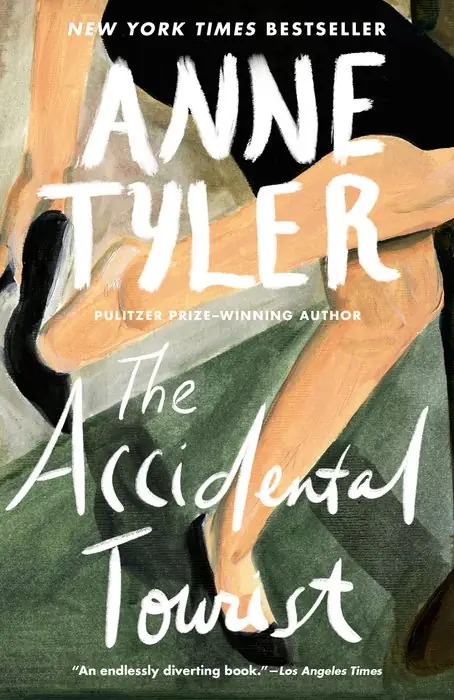
Macon Leary writes guidebooks for people who hate to travel. His series, The Accidental Tourist, with a traveling armchair for a logo, tells business travelers how to pass through Paris or London while noticing as little as possible, and it suits him, because Macon would like to pass through life the same way. His twelve year old son Ethan was shot dead in a fast food restaurant. When the book begins his wife Sarah is leaving him, and Macon is left in the Baltimore house with his systems, his sorrow and Ethan's Welsh corgi, Edward, who has started to bite.
He breaks a leg and retreats to the family house, where his sister Rose and brothers Porter and Charles live as they did as children, alphabetizing the groceries, ignoring the ringing telephone and playing card games of their own devising. There Edward takes to attacking visitors, and Macon calls in Muriel Pritchett, whom he had met while boarding the dog at the Meow-Bow Animal Hospital, a dog trainer from Singleton Street with aggressively frizzy hair, a small son named Alexander and no filter at all. She trains the dog and, almost without his consent, Macon. He moves into her narrow house, teaches Alexander practical skills, and starts to become someone different. Rose, meanwhile, marries Macon's publisher Julian. Sarah, seeing all this, decides she and Macon should try again.
The ending is in Paris. Macon goes on a research trip, injures his back, and finds both women at his hotel. He recognizes that with Sarah he was locked inside a self he had assumed for the marriage, and that with Muriel he is an entirely different person, anything but orderly. He leaves the hotel, sees Muriel on the pavement failing to get a cab, and tells his driver to stop for her. Tyler writes all this in clear, even, very funny prose, 355 pages that never hurry. Larry McMurtry, in The New York Times, called Muriel as appealing a woman as Tyler has created. Best for readers who want grief handled with a light touch and a dog.
Historical Context & Significance
The Accidental Tourist won the National Book Critics Circle Award for Fiction for 1985, presented in early 1986, over Don DeLillo's White Noise, Peter Taylor's The Old Forest and Other Stories, Richard Powers's Three Farmers on Their Way to a Dance and Larry McMurtry's Lonesome Dove. The Pulitzer reversed the order that spring: Lonesome Dove won the 1986 prize and Tyler's novel was a finalist. McMurtry had himself reviewed The Accidental Tourist admiringly in The New York Times. Knopf published it in August 1985; it was a New York Times bestseller.
The critics mostly agreed. Michiko Kakutani in the Times wrote that Tyler renders her people with such warmth and fidelity that readers are startled into appreciating the ordinary, and Jonathan Yardley in The Washington Post wrote that one cannot reasonably expect fiction to be much better than this. John Blades in the Chicago Tribune dissented, finding something annoyingly synthetic in the work and asking whether a writer with such sedative resolutions to life's most grievous problems could be taken seriously. Lawrence Kasdan's 1988 film, with William Hurt, Kathleen Turner and Geena Davis as Muriel, won Davis the Academy Award for Best Supporting Actress and was nominated for Best Picture. Tyler won the Pulitzer three years later for Breathing Lessons.
Where to get it
We may earn a commission if you buy through these links, at no extra cost to you.
Opens WorldCat, a catalogue of library holdings run by the nonprofit OCLC. We do not ask for or receive your location.