Summary
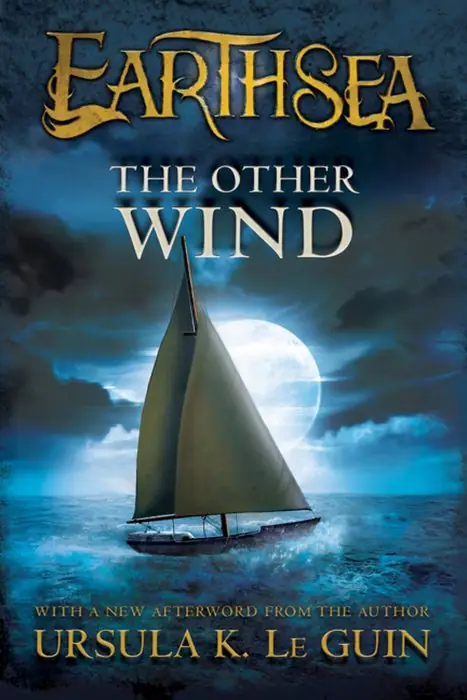
The Other Wind is the fifth and last of Ursula K. Le Guin's Earthsea novels, published by Harcourt in September 2001, and it opens with a small man and a large problem. Alder is a village sorcerer whose gift is mending: broken pots, fences. His wife, Lily, has died, and in his dreams he stands at the wall of stones that divides the living from the Dry Land of the dead, where Lily and the other dead reach across and beg him to set them free. He goes first to Roke, the island of the wizards' school, and then to Gont, to the house of Ged, the former Archmage, who has lost his power.
Ged sends Alder on to Havnor and King Lebannen, where Earthsea's other troubles are gathering. Dragons are attacking the western islands. The king of the Kargs has sent his daughter, Seserakh, as a bride Lebannen does not want. Tenar, Ged's wife, and Tehanu, their adopted daughter, who has kinship with dragons, come to the king's council, and the dragon Orm Irian arrives in human form. What emerges is that dragons and people were once one kind, and that the wizards of old made the Dry Land by walling off part of the dragons' country to win an afterlife for themselves. At the end they pull the wall down stone by stone. The dead go free, Alder follows Lily, the great dragon Kalessin finishes the work, and Tehanu becomes a dragon. Lebannen marries Seserakh, and Tenar goes home to Gont and Ged.
This is a quiet, thoughtful book with little action, in which most of the drama happens in conversation, and it asks readers to accept a deep revision of what the earlier books said about death. Read the first four Earthsea novels before it. Readers who loved Tehanu will find the arguments continued here; readers attached to the original trilogy may feel it pulls the ground out from under them.
Historical Context & Significance
The Other Wind won the World Fantasy Award for Best Novel in 2002, against a strong field: Neil Gaiman's American Gods, Lois McMaster Bujold's The Curse of Chalion, Ray Bradbury's From the Dust Returned, Charles de Lint's The Onion Girl, Jonathan Carroll's The Wooden Sea and Jay Russell's Brown Harvest. It was also a Nebula finalist in the year American Gods won that prize, a Mythopoeic Award finalist, and second in the Locus poll for fantasy novel. Publishers Weekly observed that a genre fantasy writer past seventy was not supposed to rethink her world this way, adding that "there aren't many writers around like Le Guin," while Kirkus found characters "who simply talk their way to a resolution."
The argument never quite settled. Jo Walton, rereading the book for Tor.com in 2011, wrote, "I cannot like it," because the later books cast shadows back over the early ones. Le Guin had also won World Fantasy Awards for the novella Buffalo Gals, Won't You Come Out Tonight and for life achievement. She received the National Book Foundation Medal in 2014 and died in Portland, Oregon, in January 2018, aged eighty eight.
Where to get it
We may earn a commission if you buy through these links, at no extra cost to you.
Opens WorldCat, a catalogue of library holdings run by the nonprofit OCLC. We do not ask for or receive your location.