Summary
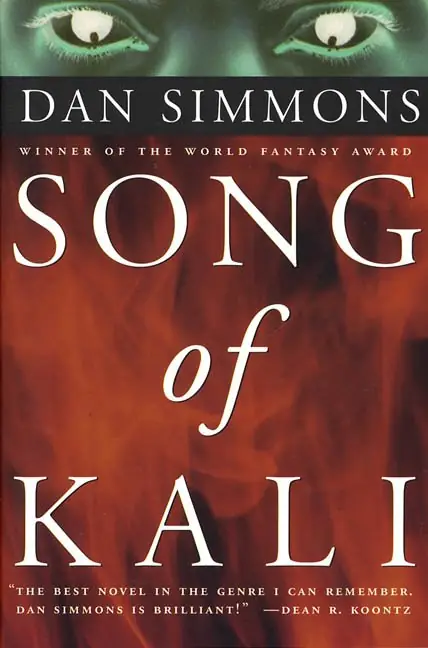
Song of Kali is a horror novel set in Calcutta in the summer of 1977. Robert Luczak, an American poet and editor, is sent by Harper's Magazine to find new work by M. Das, a celebrated Bengali poet believed to have been dead for eight years. He takes his wife, Amrita, an Indian born, British educated mathematician, and their seven month old daughter, Victoria. In the city he hears that Das did die and that the goddess Kali brought him back, and he is drawn toward a secret cult, the Kapalikas, that worships her.
Luczak does meet Das, and finds him ravaged by leprosy. He smuggles books to the poet with a revolver hidden inside them, and Das dies by the gun. The cult takes Luczak to a temple, drugs him, and there the statue of Kali seems to come alive; the book leaves open whether he sees it or dreams it. Then Victoria is abducted by Kamakhya, Amrita's friend and Das's niece, and the baby is found dead at the airport. The last part of the novel follows Robert and Amrita home in grief. Feeling the pull of the violence he met in Calcutta, he flies back there with a gun, then refuses to answer it with revenge and holds his marriage together. It ends with the couple in Colorado, expecting another child.
This was Simmons's first novel, and it reads fast: the prose is plain and the dread builds steadily toward a loss that is hard to read. The reviewer at Speculiction called it a story of redemption in which the horror is secondary, and praised prose that is "smooth and easy, stark yet evocative." Readers should know that its Calcutta is almost entirely a place of filth, menace and cruelty, which is the book's strongest effect and also the main charge made against it. It suits readers of literary horror who can take a grim, unsparing story; anyone looking for a picture of India should look elsewhere.
Historical Context & Significance
Song of Kali won the World Fantasy Award for Best Novel in 1986, a first novel beating a field that included Anne Rice's The Vampire Lestat, Clive Barker's The Damnation Game and Peter Carey's Illywhacker, along with Lisa Goldstein's The Dream Years and Paul Hazel's Winterking. Bluejay Books had published it in November 1985.
Simmons, born in Peoria, Illinois, in 1948, was working in elementary education at the time, and stayed in that work until 1989. Harlan Ellison had helped him get started, including his place at the Milford workshop in 1982. He went on to win the Hugo Award in 1990 for Hyperion, and his novel The Terror became an AMC television series in 2018. The book's picture of India has aged badly for some readers: reviewing it in 2024, James Nicoll wrote that "Simmons' version of Hinduism is such a grotesque caricature that one must assume that he did no real research at all." Simmons died in Longmont, Colorado, in February 2026, aged 77.
Where to get it
We may earn a commission if you buy through these links, at no extra cost to you.
Opens WorldCat, a catalogue of library holdings run by the nonprofit OCLC. We do not ask for or receive your location.