Summary
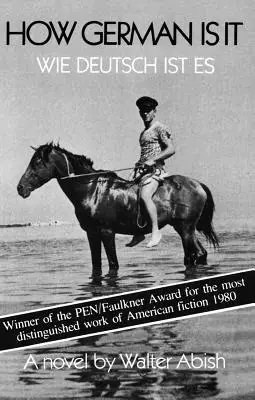
How German Is It is Walter Abish's second novel, published by New Directions in the autumn of 1980, and it is a portrait of contemporary West Germany written by a man who had fled the Nazis as a child. Ulrich Hargenau, a novelist, comes home from Paris to Wurtenburg. His father, a nobleman and officer, was executed for his part in the 1944 plot against Hitler. His brother Helmuth is a successful architect, punctual, ambitious and unfaithful, whose buildings are rising all over the country. Ulrich carries his own trouble: he testified against the Einzieh Group, the radical circle his former wife Paula belonged to, and threatening letters keep arriving.
Nearby stands Brumholdstein, a smart new town named after a philosopher who asks what a thing is and retreats to a hut in the forest, and who closely resembles Heidegger. It was built on the site of the Durst concentration camp, and when a water main bursts the workmen uncover a mass grave. A waiter named Franz spends his free time building a matchstick model of the camp. Bombs go off in buildings Helmuth designed. At the climax a drawbridge is blown up and two policemen are shot, and Ulrich learns that the dates do not work: the executed hero was not his father. The novel ends with Ulrich being hypnotized by a doctor.
Abish writes in flat, clean, deliberately neutral sentences and cuts between scenes and speakers without warning, so the book reads like a set of polished surfaces with something buried under each one. That coolness is the point, and it is also the difficulty. Kirkus found it "often fascinating as it teases, ultimately boring," and called it Abish's most cubist book. Readers who like W. G. Sebald or Thomas Bernhard, or who want a novel about how a country forgets, will find it rewards a slow second reading.
Historical Context & Significance
How German Is It won the first PEN/Faulkner Award for Fiction, in 1981. The prize had been set in motion the year before by Mary Lee Settle, who named it for William Faulkner because he had used his Nobel Prize funds to establish a prize for younger artists, and it is judged by writers. The finalists that first year were a strong field: Shirley Hazzard's The Transit of Venus, Walker Percy's The Second Coming, Gilbert Sorrentino's Aberration of Starlight and John Kennedy Toole's A Confederacy of Dunces, which won the 1981 Pulitzer Prize for Fiction.
Abish was born in Vienna in 1931, spent the war years and after in Shanghai, moved to Israel in 1949 and settled in the United States in 1957. He had begun with the experimental Alphabetical Africa (1974). He received a Guggenheim Fellowship in 1981 and a MacArthur Fellowship in 1987, published one more novel, Eclipse Fever, and a memoir, Double Vision, and died in Manhattan in May 2022, aged ninety.
Where to get it
We may earn a commission if you buy through these links, at no extra cost to you.
Opens WorldCat, a catalogue of library holdings run by the nonprofit OCLC. We do not ask for or receive your location.