Summary
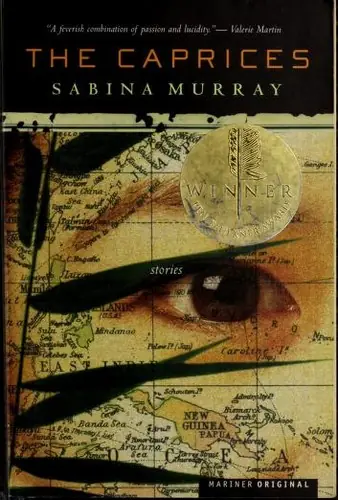
The Caprices is Sabina Murray's first collection of stories, nine of them, published by Houghton Mifflin in 2002. All nine turn on the Second World War in the Pacific, though some look back on it from decades later, and between them they move across Southeast Asia, the United States and Australia. Murray grew up in Australia and the Philippines; her mother was a child in Manila during the Japanese occupation, and her paternal grandfather and uncle were imprisoned and never heard from again. "Think of war as the hostile pebble thrown into the peaceful pond," Murray said in an interview. "I'm writing about the ripples."
The ripples reach a long way. In "Guinea" an Italian American soldier and an Irish Bostonian try to stay alive in the jungle with a Japanese prisoner in their charge. In "Order of Precedence" Lieutenant Harry Gillen, an Indian officer in the British Army, is starving in a prisoner of war camp when he meets his former commander, Major Berystede, who is dying, and the story reaches back to Gillen's polo playing days and a whites only officers' club. "Folly" imagines the last days of Amelia Earhart, and in "Colossus" an aging American veteran looks back on the Japanese invasion of the Philippines and the death march that followed. The title story, which Murray says in her foreword could just as well be set in peacetime, finds a once wealthy family living in the shell of its grand house in occupied Manila, guarding a girl named Trinidad and trying not to draw the notice of the Japanese soldiers.
This is a hard book in the plain sense. Debra Spark, writing in Ploughshares, called the stories "first and foremost about the ironies, humiliations, and brutalities of war," and Murray does not look away from starvation, disease and death. What keeps it readable is her control: the stories are tight, they jump between past and present without warning, and Publishers Weekly noted that she "also handles humor with laudable finesse." Claire Messud, in The New York Times Book Review, admired its "intriguingly ragged efficiency." It suits readers who want the war in the Pacific seen from the edges, through colonial subjects, prisoners and civilians rather than generals.
Historical Context & Significance
The Caprices won the PEN/Faulkner Award for Fiction in 2003, a first collection chosen over four finalists: William Kennedy's Roscoe, Gilbert Sorrentino's Little Casino, Peter Cameron's The City of Your Final Destination and Victor LaValle's The Ecstatic. Messud's review praised the book's "fierce intensity" and wrote that "these brimming, sometimes jagged stories endure powerfully in the reader's memory."
Murray had published one earlier book, the novel Slow Burn (1990), set in contemporary Manila. After the prize she wrote the novel A Carnivore's Inquiry (2004), Forgery (2007), Valiant Gentlemen (2016), about Roger Casement and Herbert Ward, and The Human Zoo (2021), and she received a Guggenheim Fellowship in 2007. She teaches in the MFA program at the University of Massachusetts Amherst. Grove Press reissued The Caprices in paperback in 2007.
Where to get it
We may earn a commission if you buy through these links, at no extra cost to you.
Opens WorldCat, a catalogue of library holdings run by the nonprofit OCLC. We do not ask for or receive your location.