Summary
Ragtime opens in New Rochelle, New York, in 1902, in the house of a prosperous family Doctorow never names: Father, who manufactures flags and fireworks, Mother, Mother's Younger Brother, Grandfather and a small boy. Father sails north with Robert Peary's polar expedition and comes home to a wife who has learned to run things without him. Younger Brother, brilliant with explosives and unsteady in everything else, briefly stalks the showgirl Evelyn Nesbit. Then a Black infant is found abandoned near the house; Mother takes in the child and then his despairing mother, Sarah, and admits to her parlor the man who comes courting her: Coalhouse Walker Jr., a ragtime pianist with a Model T Ford and a dignity the neighborhood cannot forgive.
A crew of volunteer firemen under Will Conklin vandalizes the car. Coalhouse asks the law for redress and learns, one office at a time, that it has none for him. Sarah dies trying to help him. He answers with a gang of young men who all call themselves Coalhouse Walker, Younger Brother among them, and the campaign ends with the Morgan Library seized and wired with dynamite. Coalhouse drops his demand for Conklin's life in return for his men's safe passage and is shot as he surrenders. Around this core Doctorow braids a second story, that of Tateh, a Jewish immigrant cutting paper silhouettes in the tenements, who loses his faith in the strike movement and remakes himself as a pioneer of moving pictures. By the close Father has gone down with the Lusitania, Younger Brother has died fighting with Zapata in Mexico, and Mother has married Tateh and taken the blended family, Coalhouse's son included, to California.
Houdini, Emma Goldman, Henry Ford, J. P. Morgan, Freud and Jung walk through the pages as characters, which stirred argument in 1975 about what a novelist may do with real people. The book is short, about 270 pages, and the first half spins among dozens of figures and anecdotes before the second half narrows onto Coalhouse and, in the novelist Jonathan Dee's phrase, flies like an arrow toward its target. Kirkus called it a great billiard game of events, ideas and personages, with America herself as the true protagonist, and noticed how funny it is. Best for readers who want the American century's opening act told fast, cool and angry.
Historical Context & Significance
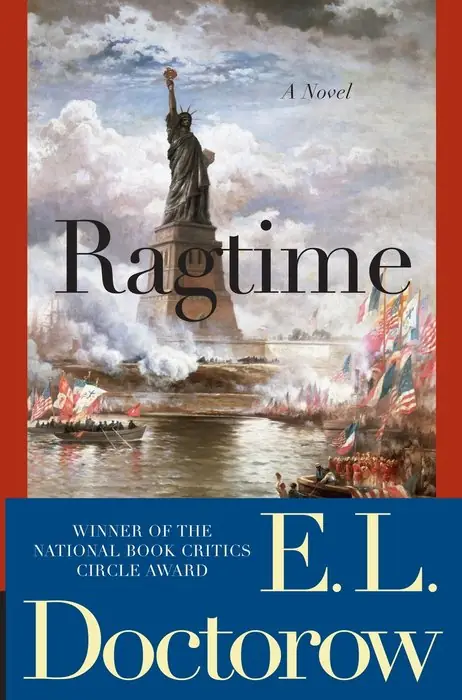
Ragtime won the National Book Critics Circle Award for Fiction for 1975, the first year the awards were given. It was the first of three NBCC fiction awards for Doctorow, who won again for Billy Bathgate (1989) and The March (2005). The American Academy and Institute of Arts and Letters gave it an award in 1976, and it drew a Nebula Award nomination.
Its afterlife has been on stage and screen. Milos Forman's 1981 film, with Howard E. Rollins Jr. as Coalhouse and James Cagney, in his last feature film, as Police Commissioner Waldo, cut Ford and Freud to concentrate on Coalhouse; it earned eight Academy Award nominations and won none. The musical by Stephen Flaherty, Lynn Ahrens and Terrence McNally opened in Toronto in 1996, reached Broadway in 1998 and won four Tony Awards, and a 2025 revival at the Vivian Beaumont Theater won the Tony for Best Revival. The Modern Library placed the novel at number 86 on its list of the century's best novels.
Where to get it
We may earn a commission if you buy through these links, at no extra cost to you.
Opens WorldCat, a catalogue of library holdings run by the nonprofit OCLC. We do not ask for or receive your location.