Summary
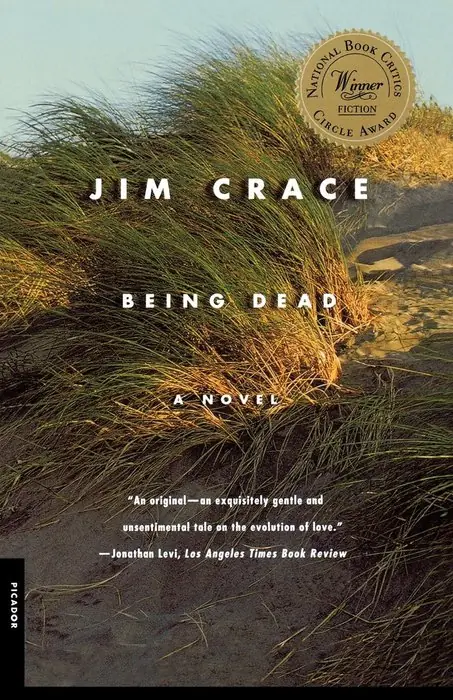
Joseph and Celice are zoologists, married for nearly thirty years, and on the first page they are already dead. They have driven out to Baritone Bay, the stretch of dunes where they met as doctoral students in the 1970s, and there an opportunistic thief has killed and robbed them and left them lying in the sand. Nobody comes for days. Crace tells the rest of the book in alternating chapters of what Publishers Weekly called chronological counterpoint. One strand moves backward through their last day, from the moment of the killing to the ordinary morning that began it. Another reaches back to the 1970s and the doctoral research on which the two first noticed each other. Between them the book stays on the dunes and records, with a naturalist's exactness, what predators and weather do to two human bodies, while their estranged daughter Syl is told they are missing and eventually that they have been found.
Crace invents his settings, and Baritone Bay belongs to no country, which frees the book from anything but its subject. Joseph holds that humankind is only marginal in the scheme of things; Celice has taught students for years that the natural sciences are the study of violence and death. The novel tests both ideas against the couple themselves, who were not saints and whose marriage was a long, ordinary one.
Publishers Weekly called it the riskiest of Crace's books and the most mesmerizing and most deeply felt, and warned that the matter of fact details of putrefaction would disturb some readers; it disturbs everyone, which is the point. John Crowley in the Washington Post called Crace an extravagantly gifted writer and the book a rare interleaving of writerly panache and common human feeling. It is under 200 pages, written in a cadenced prose that is easy to read and hard to shake, and it suits readers who can take the decomposition for the sake of what turns out to be a love story.
Historical Context & Significance
Being Dead won the National Book Critics Circle Award for Fiction for 2000, presented the following year, over Amy Bloom's A Blind Man Can See How Much I Love You, Michael Chabon's The Amazing Adventures of Kavalier and Clay, David Means's Assorted Fire Events, and Zadie Smith's White Teeth. Crace is English, born at Brocket Hall in Hertfordshire in 1946, and the novel had appeared from Viking in Britain in 1999 before Farrar, Straus and Giroux published it in the United States in April 2000; the New York Times named it an Editors' Choice of the year.
It confirmed a run that had begun with Quarantine, which won the Whitbread Novel Award for 1997 and was shortlisted for the Booker Prize. Crace went on to Harvest in 2013, a Booker finalist that won the James Tait Black Memorial Prize and the International Dublin Literary Award, and his novels have been translated into twenty eight languages. He has said he does not want facts, he wants to make things up, and Being Dead, with its invented coastline and its invented wildlife, shows what he means.
Where to get it
We may earn a commission if you buy through these links, at no extra cost to you.
Opens WorldCat, a catalogue of library holdings run by the nonprofit OCLC. We do not ask for or receive your location.