Summary
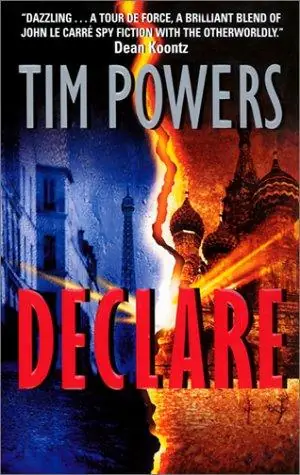
Declare is a Cold War spy novel with a secret supernatural front. In 1963 Andrew Hale, a lecturer at Oxford, is called back into a secret branch of British intelligence he believed he had left for good. From there the novel moves back and forth across three decades. Recruited as a boy, Hale worked as a double agent in occupied Paris during the Second World War, and there he fell in love with Elena Teresa Ceniza-Bendiga, a Spanish born Communist operative. In 1948 he took part in a disastrous operation on Mount Ararat. Through all of it runs Kim Philby, the real British intelligence officer who spied for Moscow, whose father, the Arabist St. John Philby, had observed strange beings in the Arabian desert and taught his son about them.
Those beings are djinn, which can take the form of rocks in the desert, and which live on Ararat, the traditional resting place of Noah's Ark. The Soviet Union has an old compact with one of them, a devouring spirit that protects Russia, and the British, French, Soviet and American services are all maneuvering for power over the rest. Imprisoned in the Lubyanka in Moscow, Elena learns what her own side has been serving and loses her faith in Communism. Hale, raised a Catholic by his mother, goes back to Ararat with Philby in 1963, and this time the mission succeeds. In the end Philby chooses to stay in Moscow, while Hale finds Elena at St. Basil's Cathedral, where she had promised to be if she survived the Lubyanka, and the novel leaves the two of them setting out to walk out of the Soviet Union.
Powers keeps every recorded fact of Philby's life and supplies a hidden reason for it, which is the book's great pleasure and also its difficulty. It is long and dense, heavy with tradecraft and mountain climbing, and some readers lose the thread. Kirkus called it one of Powers's "most absorbing and rewarding creations"; Publishers Weekly thought the spy story and the supernatural scenes "simply do not blend." It suits readers of John le Carré who are willing to follow him up a haunted mountain.
Historical Context & Significance
Declare shared the World Fantasy Award for Best Novel in 2001 with Sean Stewart's Galveston, Tim Powers's second win in the category after Last Call in 1993. Subterranean Press had issued it first as a limited edition in 2000, and William Morrow's trade edition followed in January 2001. The other finalists were Philip Pullman's The Amber Spyglass, Paula Volsky's The Grand Ellipse, Guy Gavriel Kay's Lord of Emperors and China Miéville's Perdido Street Station.
Declare also won the International Horror Guild Award for best novel, came second to George R. R. Martin's A Storm of Swords in the Locus poll for fantasy novel and was a finalist for the Mythopoeic Award. It did not appear in Britain until 2010, and that edition was shortlisted for the 2011 Arthur C. Clarke Award, which went to Lauren Beukes's Zoo City. The title comes from the Book of Job, and Powers has said he drew on St. John Philby's The Empty Quarter and on Kipling's Kim. Russ Allbery, reviewing it, found it hard going but granted that its djinn are "memorable and believably alien."
Where to get it
We may earn a commission if you buy through these links, at no extra cost to you.
Opens WorldCat, a catalogue of library holdings run by the nonprofit OCLC. We do not ask for or receive your location.