Summary
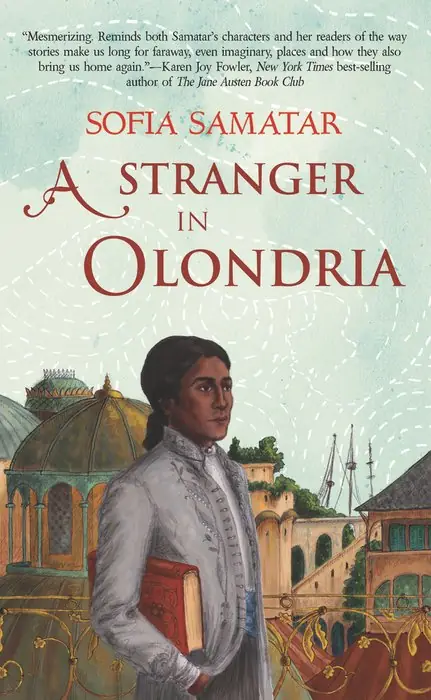
Jevick is the son of a pepper merchant from the Tea Islands, where books are almost unknown. His father is violent and ambitious; the kindness in Jevick's childhood comes from his tutor, Master Lunre, an exile from Olondria who teaches him that empire's language and its literature. Jevick falls in love with a country he has only read about. When his father dies, Jevick takes his place on the yearly selling trip. On the journey he meets Jissavet, a girl from the islands who is dying, and begins to teach her to read. In Bain, Olondria's capital, after he joins the revels of the Feast of Birds, Jevick wakes to find himself visited by Jissavet's ghost, and she will not leave him.
When he confesses the haunting to an innkeeper, Jevick is arrested, and he becomes a pawn in the struggle between the empire's two most powerful cults: the Priest of Stone, who stands for the authority of the written word, and the High Priest of Avalei, whose followers keep the old spirit rites alive underground. Jevick is imprisoned, escapes with the help of Tialon, the Priest of Stone's daughter, and witnesses a massacre at a secret night gathering that pushes the country toward war. What the ghost wants is simple and enormous: that he write her life into a book. He does, burns her bones as island custom requires, and goes home, where he uses her words to begin writing down his own language and teaches it to the children.
This is a novel for readers who read for sentences. The pages are thick with the taste of fruit, the smell of streets and the feel of old books, and the plot moves slowly beneath all that description; some readers find it too slow. Its hero is an observer more than a doer. Nic Clarke, reviewing it in Strange Horizons, granted that Jevick and Jissavet "are not an unambiguously appealing pair," but found that their collaboration makes "something bigger than either of them." It suits readers of Ursula K. Le Guin, and anyone who loves books about the power and danger of reading.
Historical Context & Significance
A Stranger in Olondria won the 2014 World Fantasy Award for Best Novel, presented in Washington, D.C., over Richard Bowes's Dust Devil on a Quiet Street, Helene Wecker's The Golem and the Jinni, Gene Wolfe's The Land Across, Marie Brennan's A Natural History of Dragons and Neil Gaiman's The Ocean at the End of the Lane. It was Samatar's first novel, published by Small Beer Press in April 2013, and it had a remarkable year. It also won the British Fantasy Award for best fantasy novel and the Crawford Award, was a Nebula finalist alongside The Golem and the Jinni and The Ocean at the End of the Lane, and placed third in the Locus poll for first novel, while Samatar won the John W. Campbell Award for Best New Writer.
Samatar was born in Indiana in 1971 to a Somali historian father and a Swiss-German Mennonite mother. She wrote the first draft in South Sudan, which inspired the Tea Islands, and revised it in Alexandria. She returned to Olondria in The Winged Histories (2016) and later wrote the memoir The White Mosque (2022).
Where to get it
We may earn a commission if you buy through these links, at no extra cost to you.
Opens WorldCat, a catalogue of library holdings run by the nonprofit OCLC. We do not ask for or receive your location.