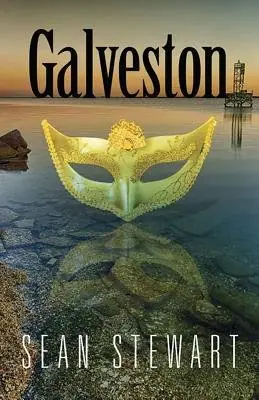
Summary
Galveston is set on the real island city off the Texas coast, in a near future where magic has come back into the world. In 2004 a Flood of magic broke over Galveston during Mardi Gras, and it split the city in two. On one side is an ordinary Galveston of survivors. On the other is Carnival, a Mardi Gras that never ends, full of people and creatures bent into strange shapes and presided over by Momus, the god who rules that part of the city. Two women built and still keep the boundary between them: Jane Gardner, who runs the ordinary city, and Odessa Gibbons, known as the Recluse.
A generation on, both are old, and Jane is dying. Her daughter Sloane, in her early twenties and dreading the job she is meant to inherit, makes a bargain with Momus to save her mother, and the bargain goes badly wrong. Josh Cane, a bitter young apothecary whose family lost everything in a poker game, and who was fond of Sloane as a child and is embittered that she has forgotten him completely, becomes tangled in the consequences. He and his loyal friend Ham Mather are falsely accused and banished to the mainland, where they have to survive the wild coast, its people and a hurricane. The storm lets magic loose through the city Jane and Odessa kept safe, and the line between the two Galvestons dissolves.
Stewart is most interested in character, and in the way people's flaws have real consequences. Josh is hard company for much of the book, and Sloane's choices are infuriating, which is the point. The writing about Carnival is vivid and often funny, and the mainland chapters are grim. Readers differ on the pace: the reviewer Rich Horton found it "an absorbing book, a wonderful read" but noted that it "doesn't really end so much as stop," while a later reader found it "incredibly slow." It suits readers who like fantasy with an adult, morally serious edge, and anyone who knows the Gulf Coast.
Historical Context & Significance
Galveston shared the World Fantasy Award for Best Novel in 2001 with Tim Powers's Declare. The other finalists that year were Philip Pullman's The Amber Spyglass, Paula Volsky's The Grand Ellipse, Guy Gavriel Kay's Lord of Emperors and China Miéville's Perdido Street Station. Ace had published it in 2000. It also won the first Sunburst Award, the Canadian prize for fiction of the fantastic, in 2001, and placed sixth in the Locus poll for fantasy novel.
The book shares a background with Stewart's earlier Resurrection Man (1995) and The Night Watch (1997), an alternate history in which magic breaks into ordinary life after the Second World War, though each tells its own story; The Encyclopedia of Science Fiction calls Galveston "the strongest of them." Stewart was born in Lubbock, Texas, in 1965 and grew up in Edmonton, Alberta. His next novel, Perfect Circle, was a World Fantasy finalist in 2005, and he later turned to alternate reality games, including The Beast, and to the Cathy's Book series written with Jordan Weisman.
Where to get it
We may earn a commission if you buy through these links, at no extra cost to you.
Opens WorldCat, a catalogue of library holdings run by the nonprofit OCLC. We do not ask for or receive your location.