Summary
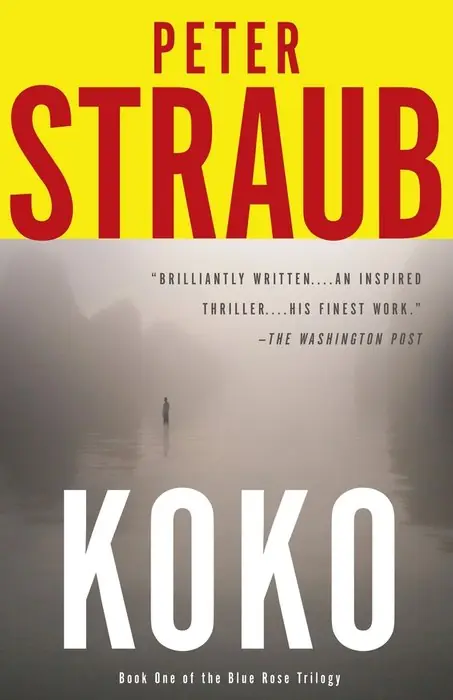
Koko begins with a string of killings across Southeast Asia in the early 1980s. The victims have had their eyes and ears cut away, and each has a playing card in its mouth with the word Koko written on it. Four men who served in the same platoon in Vietnam recognize the signature. Michael Poole is a grieving pediatrician, Tina Pumo runs a restaurant in New York, Conor Linklater drifts from one construction job to the next, and Harry Beevers is an opportunistic lawyer. They meet at the Vietnam Veterans Memorial in Washington and decide the killer must be Tim Underhill, a fellow veteran turned novelist who is somewhere in Asia.
Three of them fly to Singapore and Bangkok to find him while Pumo stays home, and the killer travels the other way, to New York, where he murders Pumo. The truth, when it comes, is that Koko is Manny Dengler, a member of their own unit whom they had believed dead: he had killed another soldier, Victor Spitalny, and taken his identity, and his rage goes back to a massacre in Vietnam led by Beevers. The survivors corner him in a basement in Chinatown, where he stabs Poole and Underhill and gets away. He escapes to Honduras and is never caught, and the novel closes with Underhill imagining his first uneasy days there.
This is a long book, more than five hundred pages, and it moves slowly. Straub spends as much time on the four men, their guilt and their memories of the war as on the hunt itself. There is nothing supernatural in it. Kirkus likened it to a rumbling tank of a thriller and judged it, in the end, "an honorable, mighty failure," complaining that the characters stay static and the plot meanders. Readers who want a war novel and a crime novel at once, and have the patience for its length, will find it haunting.
Historical Context & Significance
Koko won the World Fantasy Award for Best Novel in 1989, against Thomas Harris's The Silence of the Lambs, Joe R. Lansdale's The Drive-In, Robert Cormier's Fade, James P. Blaylock's The Last Coin and Jonathan Carroll's Sleeping in Flame. Dutton had published it in 1988, with Viking in Britain. It also placed fourth in the Locus poll for best horror novel that year.
Straub, born in Milwaukee in 1943, was already known for Julia, Ghost Story and Floating Dragon, and for The Talisman, written with Stephen King, which had been a finalist for this same award four years earlier. Koko opened what became his Blue Rose trilogy, followed by Mystery (1990) and The Throat (1993). Koko was a departure for him: a horrific novel about the Vietnam War and its aftermath with nothing supernatural in it. He died in New York in September 2022, aged 79.
Where to get it
We may earn a commission if you buy through these links, at no extra cost to you.
Opens WorldCat, a catalogue of library holdings run by the nonprofit OCLC. We do not ask for or receive your location.