Summary
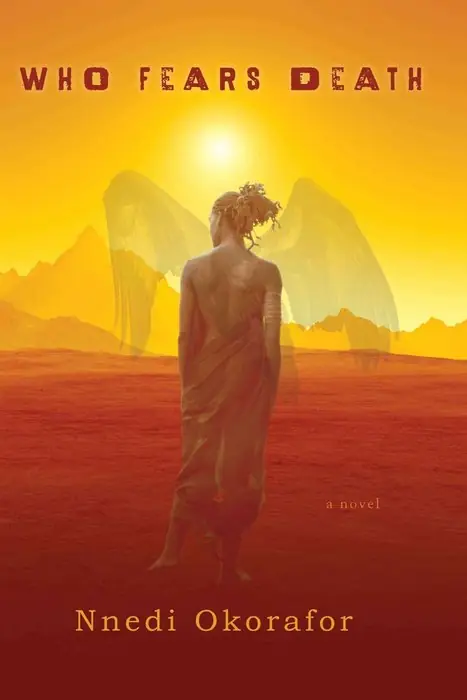
Who Fears Death is set in a desert Africa long after some catastrophe, in a world divided by slavery and genocide, where the Nuru rule and the Okeke are their victims. Onyesonwu, whose name means "who fears death?", was conceived when a Nuru man raped her Okeke mother, Najeeba. That makes her Ewu, a child of both peoples whom everyone can recognize and most people shun. Mother and daughter live alone in the desert for years before settling in the town of Jwahir, where Najeeba marries a blacksmith, Fadil Ogundimu. At eleven, against her parents' wishes and hoping to be accepted, Onyesonwu undergoes ritual circumcision. The cutting marks her body and her magic, and it alerts her real father, the sorcerer Daib, to her existence.
She finds friends in three girls who went through the rite with her, Binta, Diti and Luyu, and in Mwita, an Ewu boy who becomes her lover. The sorcerer Aro at first refuses to teach her because she is a girl, then gives in, and she learns that she can change shape, raise dead animals and travel in the spirit world. She also learns a prophecy: she will die by stoning. She sets out with Mwita and her friends to stop the killing of the Okeke, and the journey costs them dearly. In the Nuru city of Durfa she attacks her father, and Mwita is killed in the fight. On an island she finds the Great Book and rewrites it in Nsibidi script to undo the oppression written into it. She tells the whole story to a Nuru journalist while she awaits execution, and the novel offers two endings: in one she is stoned to death, in the other she escapes as a Kponyungo, a creature like a dragon, and flies east to meet Mwita.
Okorafor puts rape, genital cutting and massacre on the page and does not soften them, and Onyesonwu is angry, proud and often wrong. Publishers Weekly called the novel "a fantastical, magical blend of grand storytelling." Farah Mendlesohn, in Strange Horizons, disagreed, finding the narration "curiously flat," its scenes of horror "bleached," and the magic too often "a fix, a way to remove trauma". It suits readers of Octavia E. Butler, and anyone who wants fantasy rooted in African places and politics.
Historical Context & Significance
Who Fears Death won the 2011 World Fantasy Award for Best Novel, presented at the convention in San Diego. The finalists were N. K. Jemisin's The Hundred Thousand Kingdoms, Karen Lord's Redemption in Indigo, Graham Joyce's The Silent Land, Guy Gavriel Kay's Under Heaven and Lauren Beukes's Zoo City. DAW had published it in June 2010, and Publishers Weekly noted it was Okorafor's first novel for adults after her books for younger readers. It was also a Nebula finalist that year, in a field won by Connie Willis's Blackout/All Clear that again included The Hundred Thousand Kingdoms, and it won the Carl Brandon Society's Kindred Award.
Okorafor was born in Cincinnati in 1974 to Igbo Nigerian parents. She went on to win the Nebula and the Hugo for her novella Binti, and in 2015 she published The Book of Phoenix, a prequel to this novel. HBO took Who Fears Death into development as a television series, with George R. R. Martin as an executive producer, and Tessa Thompson's production company joined the project in 2021.
Where to get it
We may earn a commission if you buy through these links, at no extra cost to you.
Opens WorldCat, a catalogue of library holdings run by the nonprofit OCLC. We do not ask for or receive your location.