Summary
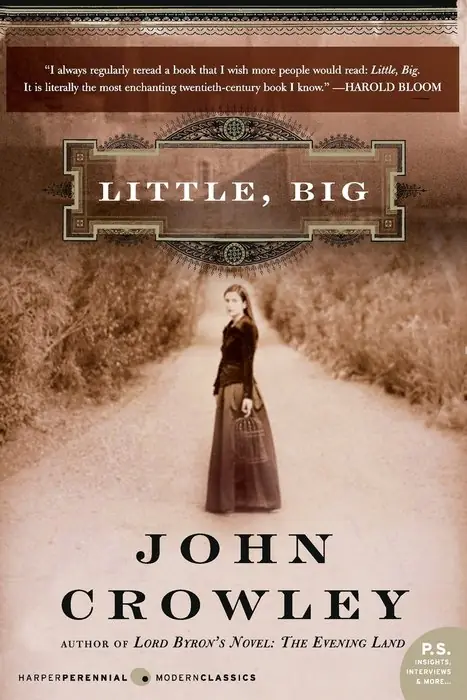
Little, Big follows several generations of the Drinkwater family and the house they live in, Edgewood, somewhere north of New York City. The architect John Drinkwater designed it after he and his English wife, Violet Bramble, found that the world of the fairies lies nested within ours, each world larger than the one that contains it. The house is a door. The novel opens with a young man named Smoky Barnable traveling to Edgewood to marry Daily Alice Drinkwater, whom he met through her cousin George Mouse, and slowly learning that his new family lives by a story whose shape only some of them can see.
The book then spreads across decades. Alice and Smoky have four children, among them Auberon, who goes to the city, falls in love with Sylvie, loses her to the other world and sinks into drink. Alice's sister Sophie keeps an old deck of cards that turns out to be a map; her daughter Lilac is taken by the fairies and replaced by a changeling. Meanwhile Russell Eigenblick, who is the Emperor Frederick Barbarossa awakened, rises to the presidency of the United States, and Ariel Hawksquill, a magician distantly related to the family, sets out to stop him. At the end the family gathers at Edgewood on Midsummer's Day to go into the other world and take the fairies' place. Smoky, who has just repaired the house's orrery, dies of a heart attack at its border, and his funeral becomes Auberon and Sylvie's wedding.
This is a long, slow, patient book. The first hundred pages ask the reader to keep a family tree straight, the momentum is deliberately muted, and the ending leaves its mysteries unexplained. One careful reviewer, Russ Allbery, called it "a beautiful, evocative book that I found difficult to get through." What rewards the effort is the atmosphere and the sentences, which have made it a book people press on each other. It suits readers of Lewis Carroll, Nabokov or Gabriel García Márquez who like to live in a novel for weeks.
Historical Context & Significance
Little, Big won the World Fantasy Award for Best Novel in 1982. Bantam published it as a paperback original in August 1981. It beat Gene Wolfe's The Claw of the Conciliator, Ramsey Campbell's The Nameless, Michael Moorcock's The War Hound and the World's Pain and D. M. Thomas's The White Hotel. It also won the Mythopoeic Fantasy Award, was a finalist for the 1982 Hugo and for the Nebula for the novels of 1981, placed second among fantasy novels in the Locus poll, and was shortlisted for the British Science Fiction Association Award.
Ursula K. Le Guin wrote that it "all by itself calls for a redefinition of fantasy," and Harold Bloom named it "a neglected masterpiece." Crowley went on to write the four Aegypt novels, taught at Yale from 1993, and received the World Fantasy Award for Life Achievement in 2006. He died in Conway, Massachusetts, on August 8, 2026, at eighty three. An illustrated edition from Incunabula, long in the making, appeared in 2022.
Where to get it
We may earn a commission if you buy through these links, at no extra cost to you.
Opens WorldCat, a catalogue of library holdings run by the nonprofit OCLC. We do not ask for or receive your location.