Summary
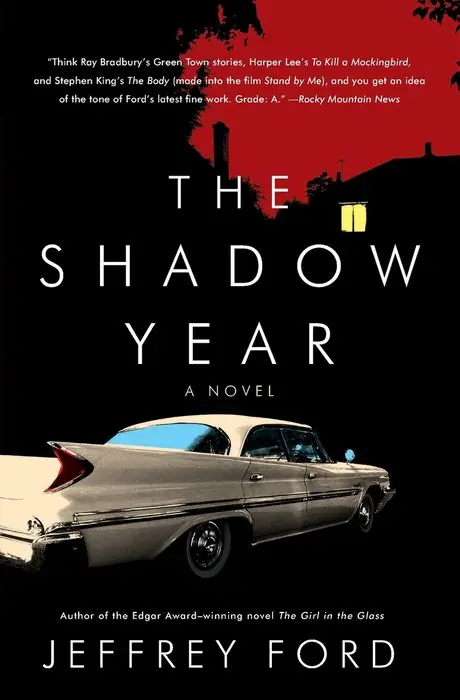
The Shadow Year is set on Long Island in the mid 1960s and told by a boy in the sixth grade who never gives his name. His father works three jobs and is rarely home; his mother drinks herself to sleep most nights. He spends his days with his older brother, Jim, and their younger sister, Mary, who is strange, brilliant with numbers, and sometimes lives as an imaginary boy called Mickey. In the basement Jim has built Botch Town, a scale model of their neighborhood with a figure for each of the people in it.
Then things start to go wrong. A classmate, Charlie Edison, disappears. A prowler is seen at windows. A menacing man in a white car, whom the children call Mr. White, seems to be following the narrator around the neighborhood and the school, and after a blizzard an old man, Mr. Barzita, is found dead. Most unsettling of all, Mary has begun moving the figures in Botch Town, and what she arranges in the basement keeps showing what will happen in the streets before it happens. The three children set out to catch Mr. White themselves, using Mary's numbers and her model as their map. Ford does eventually reveal who the man in the white car is, but not why he fixed on the narrator, and much of what the children see and overhear is never explained.
This is a slow, remembering kind of book, closer to a childhood memoir with a shadow across it than to a thriller, and the pleasure is in the detail: the ice cream truck, the school bully, the loving but broken parents seen clearly by children who cannot yet judge them. Kirkus found it "properly creepy" and at times "deliciously funny." Readers who want a mystery that builds to a big climax may feel shortchanged; Publishers Weekly complained that the story "peters out." Readers who grew up on Ray Bradbury, or on Stephen King's novels of childhood, will know the territory and enjoy the visit.
Historical Context & Significance
The Shadow Year shared the 2009 World Fantasy Award for Best Novel with Margo Lanagan's Tender Morsels, at the convention in San Jose. The other finalists were Neil Gaiman's The Graveyard Book, Kage Baker's The House of the Stag and Daryl Gregory's Pandemonium. It was Ford's second Best Novel win, after The Physiognomy in 1998, and the same year he also won the award for best collection with The Drowned Life. Earlier that summer the novel had won the Shirley Jackson Award for best novel, presented at Readercon in July 2009, over a field that included both Tender Morsels and Pandemonium.
Morrow published the book in March 2008. It grew out of "Botch Town," a novella in Ford's collection The Empire of Ice Cream that won the World Fantasy Award for novella in 2007, and the basement model has its origin in a train set Ford and his brother had as boys. Ford was born in West Islip, on Long Island, in 1955 and studied with the novelist John Gardner at Binghamton. He had won the Edgar Award in 2006 for The Girl in the Glass.
Where to get it
We may earn a commission if you buy through these links, at no extra cost to you.
Opens WorldCat, a catalogue of library holdings run by the nonprofit OCLC. We do not ask for or receive your location.