Summary
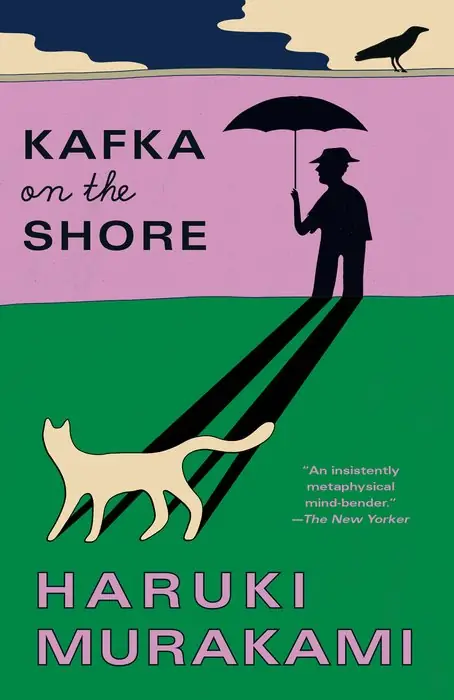
Kafka on the Shore tells two stories in alternating chapters until they meet. In one, a fifteen year old boy runs away from his father's house in Tokyo. He calls himself Kafka Tamura, and his real first name is never given. His father has laid a prophecy on him, like the one in Oedipus, and Kafka is also looking for his missing mother and sister. He takes a bus to Shikoku, meets a young woman named Sakura, and finds shelter in the Komura Memorial Library in Takamatsu, run by the reserved Miss Saeki and the young librarian Oshima. When his father is found murdered in Tokyo, the police start looking for him, and Oshima hides him in a cabin in the forests of Kōchi.
In the other story, Satoru Nakata is an old man who, as a schoolboy in 1944, was one of sixteen children who lost consciousness on a hillside in a strange incident. He woke unable to read or write but able to talk to cats, and he earns a little by finding lost ones. When he kills a cat killer who calls himself Johnnie Walker, something drives Nakata west, with a young truck driver named Hoshino for company. Fish fall from the sky, and a figure who looks like Colonel Sanders turns up. In the end Nakata dies in his sleep, Hoshino closes the entrance stone and kills a creature that comes out of Nakata's body, Miss Saeki dies at her desk, and Kafka, after meeting her younger self deep in the forest, takes the train back to Tokyo to return to school.
It reads quickly for a long book, carried along by Murakami's plain, conversational sentences, but it leaves its central mysteries open, and that frustrates some readers. Publishers Weekly warned that "things swirl a bit at the end." It suits readers who enjoy dreamlike fiction, and those new to Murakami could start here.
Historical Context & Significance
Kafka on the Shore won the World Fantasy Award for Best Novel in 2006, over Graham Joyce's The Limits of Enchantment, Bret Easton Ellis's Lunar Park, Patricia A. McKillip's Od Magic, Paul Park's A Princess of Roumania and Hal Duncan's Vellum. Shinchosha had published it in Japan in 2002, and Knopf brought out Philip Gabriel's English translation in January 2005, with Harvill in Britain. Gabriel won the 2006 PEN Translation Prize for it, and Kirkus called the book "A masterpiece" worthy of the Nobel Prize.
The same year, 2006, Murakami received the Franz Kafka Prize. Born in Kyoto in 1949, he had already written Norwegian Wood and The Wind-Up Bird Chronicle, and 1Q84 followed. The novel has had a life on stage: Frank Galati adapted it for the stage at Steppenwolf in Chicago, and Yukio Ninagawa's Japanese language production of Galati's script played the Barbican in London in 2015.
Where to get it
We may earn a commission if you buy through these links, at no extra cost to you.
Opens WorldCat, a catalogue of library holdings run by the nonprofit OCLC. We do not ask for or receive your location.