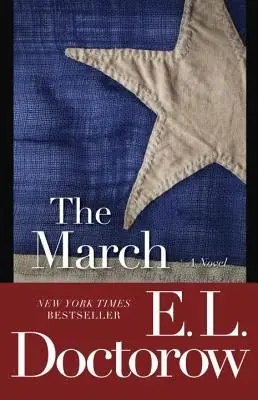
Summary
Late in 1864 William Tecumseh Sherman took sixty thousand Union troops out of Atlanta and marched them to Savannah and then north through the Carolinas, living off the land and leaving a sixty mile wide scar behind them. The March is that campaign told from inside the column and from the roads and ruined houses beside it. Doctorow gives it no main character. Pearl is a white planter's daughter by an enslaved woman, freed when the army reaches the plantation and passing at first as a drummer boy. Wrede Sartorius is a German trained army surgeon, brilliant and cold, who tries new techniques on his patients and leaves himself no time for feeling. Emily Thompson, a displaced aristocrat from Milledgeville with nothing left, attaches herself to him as nurse and then lover. Arly and Will are two Confederate soldiers who change coats as often as the odds change, playing the Shakespearean fools of the book, comic one page and desolate the next. Stephen Walsh is a Union soldier who cannot find a reason for any of it until Pearl gives him one. Behind them all moves Sherman himself, an unstable strategic genius, charismatic and detached, idolized by his men and by the freed people who follow the army in their thousands, longing for a war more romantic than the one he is winning.
The book moves as the army does, in short scenes that hand the story from one character to the next, from Georgia into the Carolinas and on to Lee's surrender and the news of Lincoln's murder on April 14, 1865. Doctorow ends on the freed and the soldiers looking forward with cautious hope and carrying the war in their bodies, and on a last image of a dead soldier's boot and shredded uniform in the dirt.
Publishers Weekly called it a kind of grim Civil War Canterbury Tales and praised Doctorow's gift for getting into the heads of a remarkable variety of characters, famous or ordinary, while admitting the prose sometimes tips into sentiment. Kirkus said Doctorow's previous novels had earned multiple major literary awards and that The March should do so as well. It runs about 360 pages, reads quickly for its size, and suits readers of Cold Mountain and of Ragtime, whose crowded, quick cutting method it revives thirty years on.
Historical Context & Significance
The March won the National Book Critics Circle Award for Fiction for 2005, presented the following year, over Mary Gaitskill's Veronica, Andrea Levy's Small Island, Kazuo Ishiguro's Never Let Me Go, and William T. Vollmann's Europe Central. It was Doctorow's third NBCC fiction award, after Ragtime for 1975 and Billy Bathgate for 1989, a record no other novelist has matched in the prize's history. The same season it was a finalist for the 2005 National Book Award, which went to Vollmann's Europe Central, and for the 2006 Pulitzer Prize, which went to another Civil War novel, Geraldine Brooks's March. It won the 2006 PEN/Faulkner Award, Doctorow's second after Billy Bathgate in 1990, and the 2006 Michael Shaara Award for Civil War fiction.
Random House published it in September 2005, his tenth novel, and Kirkus caught in it a brief appearance by a Coalhouse Walker, a graceful nod to Ragtime. Steppenwolf Theatre Company in Chicago staged Frank Galati's adaptation in the spring of 2012.
Where to get it
We may earn a commission if you buy through these links, at no extra cost to you.
Opens WorldCat, a catalogue of library holdings run by the nonprofit OCLC. We do not ask for or receive your location.