Summary
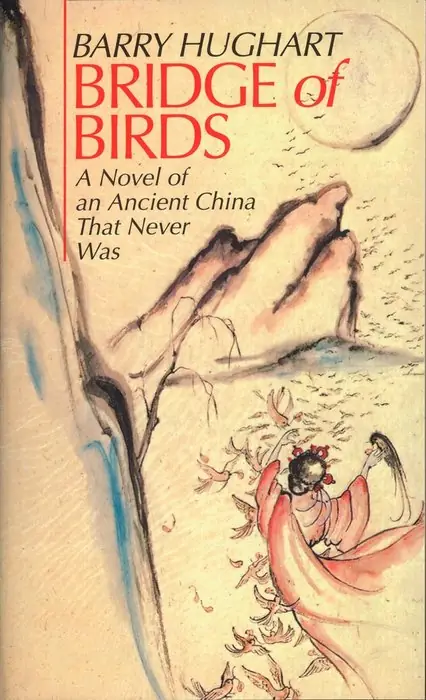
Bridge of Birds is a comic quest novel set in a China of legend rather than of history, and it is narrated by a young man called Number Ten Ox, a strong, honest orphan from a small village of silk growers. A plague strikes it: the silkworms are poisoned, and every child between eight and thirteen falls into a coma. Ox goes to Peking to find a wise man and comes back with Li Kao, an elderly scholar who cheerfully admits to a slight flaw in his character. Master Li identifies the cause as ku poison, administered by two dishonest villagers, and concludes that only the Great Root of Power can wake the children.
The search takes the old man and the young one across the empire. They fall in with characters such as Miser Shen and Henpecked Ho, and every trail leads toward the Duke of Ch'in, a tyrant who removed his own heart to make himself invulnerable and hid it in a casket beneath a frozen lake. What look at first like separate escapades turn out to be bound together by the old legend of the Cowherd and the Weaver Girl, and by a children's rhyme and game. At the climax the beautiful Lotus Cloud is revealed as Jade Pearl, the Princess of Birds, whose crown the Duke stole centuries before. Master Li and Ox find the Duke's heart, Lotus Cloud helps destroy it, the birds form a bridge to heaven so that the Star Shepherd can be reunited with his princess, and the Great Root cures the children.
The book is short and quick, told in the voice of a fable, and very funny. It is also, as the critic Rich Horton put it, "often rather horrifyingly bloody," and the early chapters can feel like a string of unconnected adventures until the pattern shows itself. Kirkus summed up the mix as "Disney Studios, the Brothers Grimm, and Dungeons & Dragons in roughly equal proportions." Readers who like Terry Pratchett, or who want a fantasy that makes them laugh and then catches them off guard, should start here.
Historical Context & Significance
Bridge of Birds shared the World Fantasy Award for Best Novel in 1985 with Robert Holdstock's Mythago Wood, the first time the category ended in a tie. The other finalists were Diana Wynne Jones's Archer's Goon, T. E. D. Klein's The Ceremonies, and The Talisman by Stephen King and Peter Straub. St. Martin's had published it in 1984. It went on to win the Mythopoeic Fantasy Award in 1986, over Ursula K. Le Guin's Always Coming Home and Diana Wynne Jones's Fire and Hemlock among others.
Hughart, born in Peoria, Illinois, in 1934, published this, his first novel under his own name, at fifty, after service in the Air Force, years working for a military surplus company in Asia and a spell managing a bookshop in New York. He planned seven books about Master Li and Number Ten Ox and wrote three, adding The Story of the Stone and Eight Skilled Gentlemen. In a 2000 interview he blamed his publishers, who among other failures had not sent so much as a postcard when he won the World Fantasy Award. He died in August 2019, aged 85.
Where to get it
We may earn a commission if you buy through these links, at no extra cost to you.
Opens WorldCat, a catalogue of library holdings run by the nonprofit OCLC. We do not ask for or receive your location.