Summary
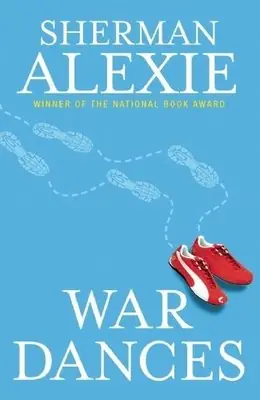
War Dances is a book by Sherman Alexie, published by Grove in October 2009, that refuses to be one thing. It mixes short stories, poems, question and answer sequences and hybrids of all of them, twenty three pieces in all, and many of them turn on fathers and sons. Alexie grew up on the Spokane Indian Reservation, and the best of these pieces draw on that life.
The longest and strongest is the title story, thirty six pages in sixteen short chapters, some only two paragraphs long. It ties together a hospitalized father's fatal alcoholism and the nonmalignant brain tumor of his son, a forty one year old Native American writer who, in one comic episode, is himself accused of stereotyping another Indian. In "Breaking and Entering" the narrator, a film editor, shapes the facts of an incident that changes his life to fit his own story, then feels wronged when the media edit it their way. "Fearful Symmetry" follows Sherwin Polatkin, a young short story writer and poet working as a screenwriter for a Hollywood studio, and the poem "Ode to Mix Tapes" makes the case for hard work as the root of anything made well. Alexie has said he built the book the way you build a mix tape: "the first song you come out with has to be a barnburner."
Reading it is a ride with bumps. The voice is quick, profane and very funny, and it can turn to grief in a line. Publishers Weekly admired "a penetrating voice that mixes humor with anger" and called the whole "a spiritedly provocative array of tragic comedies," while admitting that "at times his jokes bomb." Kirkus was harder on it, calling the book "wildly uneven" and most of the verse "slapdash and singsong," and concluded that "The author's considerable talent is only intermittently in evidence here." The title story is the reason to come, and the rest rewards readers who like a writer in an experimental, argumentative mood.
Historical Context & Significance
War Dances won the PEN/Faulkner Award for Fiction in 2010, chosen from close to 350 books by the judges Rilla Askew, Kyoko Mori and Al Young. "That book was the one we all liked immediately," Mori said, and although she usually disliked books that mix prose and poetry, she found that "here the poetry was like listening to an interlude and got you ready for the next story." Young called it a "rollicking, bittersweet gem of a book." It beat Barbara Kingsolver's The Lacuna, Lorraine López's Homicide Survivors Picnic, Lorrie Moore's A Gate at the Stairs and Colson Whitehead's Sag Harbor, and Alexie received $15,000, with the five writers to be honored on May 8 at the prize's thirtieth anniversary celebration.
Alexie came to it from his first novel for young adults, which won the 2007 National Book Award for Young People's Literature, and said he had wanted to write a book that was "a reverse of that." In 2018, after accusations of sexual misconduct, he acknowledged that "Over the years, I have done things that have harmed other people," and he declined the Carnegie Medal; the American Indian Library Association rescinded the 2008 award it had given his first novel for young adults.
Where to get it
We may earn a commission if you buy through these links, at no extra cost to you.
Opens WorldCat, a catalogue of library holdings run by the nonprofit OCLC. We do not ask for or receive your location.