Summary
Ailey Pearl Garfield is the youngest daughter of Geoff Garfield, a light skinned Washington physician, and Belle Driskell Garfield, a schoolteacher from the small Georgia town of Chicasetta, where the family has lived since slavery. Honorée Fanonne Jeffers follows Ailey from a girlhood in the 1980s and 1990s, split between the city and summers in Chicasetta, through a historically Black college and into graduate school, where she defies the family expectation that she become a doctor and trains as a historian instead. Her great uncle Root, a retired history professor and lifelong devotee of W.E.B. Du Bois, is her guide; her brilliant older sister Lydia, whose promise is broken by sexual abuse and then crack addiction, is the family's wound; her graduate mentor, Dr. Oludara, sends her into the archives.
Between the chapters of Ailey's life run the "Songs," sections that go back through her ancestors of African, Creek and Scottish descent to the land that became Chicasetta and to Samuel Pinchard, the white planter who owned and raped the enslaved people from whom she descends. Epigraphs from Du Bois open the sections, and his idea of the Talented Tenth hangs over a family that has produced doctors and professors and still cannot protect its daughters. Ailey's research eventually brings the two strands together, and the last Song returns to slavery's founding crime.
At just over eight hundred pages this is a long book and a slow one on purpose; Ron Charles in the Washington Post called it "a mountain to climb" and also "simply magnificent." Veronica Chambers in the New York Times said it was "quite simply the best book that I have read in a very, very long time," and Kirkus wrote, "If this isn't the Great American Novel, it's a mighty attempt at achieving one." Jeffers is a poet, and the prose shows it. It suits readers who loved Homegoing or Roots and want a family novel with the archive built in.
Historical Context & Significance
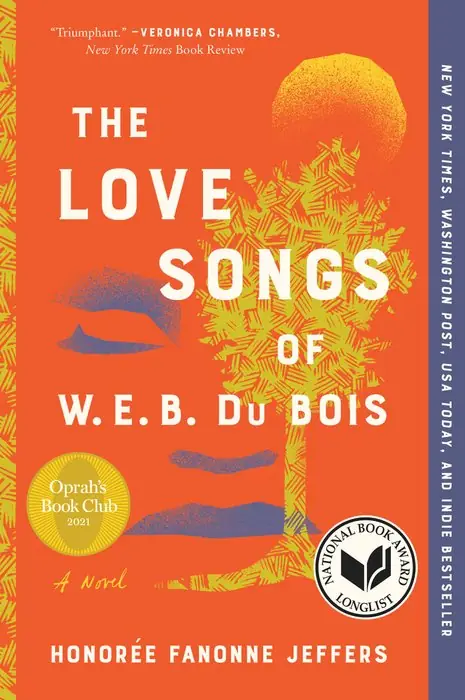
The Love Songs of W.E.B. Du Bois won the National Book Critics Circle Award for Fiction for 2021, announced on March 17, 2022, over Joshua Cohen's The Netanyahus, Rachel Cusk's Second Place, Sarah Hall's Burntcoat and Colson Whitehead's Harlem Shuffle. It had been longlisted for the 2021 National Book Award and was a finalist for the 2021 Kirkus Prize, and Oprah Winfrey chose it for her book club on publication day. Both the New York Times Book Review and the Washington Post named it one of the ten best books of 2021.
It was a first novel by a poet of fifty three. Jeffers, born in Kokomo, Indiana, in 1967, had published five collections, the most recent of them The Age of Phillis (2020), which was longlisted for the National Book Award for Poetry and won an NAACP Image Award. Her agent, Sarah Burnes, who had signed her on the strength of a short story, received the manuscript early in 2016; it grew from 450 pages to about 900 in editing with Erin Wicks at Harper, who published it on August 24, 2021. Jeffers teaches creative writing at the University of Oklahoma.
Where to get it
We may earn a commission if you buy through these links, at no extra cost to you.
Opens WorldCat, a catalogue of library holdings run by the nonprofit OCLC. We do not ask for or receive your location.