Summary
Khaled Abd al Hady leaves Benghazi in 1983, still in his teens, to study at the University of Edinburgh, and never goes home. At Edinburgh he befriends another Libyan student, Mustafa al Touny, who persuades him to join a demonstration against the Gaddafi regime outside the Libyan embassy in St James's Square, London, in April 1984. Men inside the embassy open fire on the crowd. Both friends are wounded and taken to hospital under police guard, then granted asylum, and Khaled understands that he can neither return nor safely tell his family what has happened to him.
The third friend is Hosam Zowa, a writer whose short story, an allegory of the regime, was read on the BBC Arabic Service; the presenter who read it was later murdered near Regent's Park Mosque by Libyan agents. Khaled had heard the broadcast as a boy in Benghazi, and when he meets Hosam in the 1990s the friendship becomes the center of his life. The novel runs across three decades of that life in London, a schoolteacher's life, measured and careful, and it turns on 2011, when the Arab Spring reaches Libya. Mustafa goes back and joins a militia. Hosam goes back too, falls in love, fights, and ends up disillusioned with what follows the revolution and bound for America. Khaled stays. Matar tells it in Khaled's voice as he walks across London after a farewell, and the long walk holds the whole book.
It is a quiet novel of interiors and conversations, and readers expecting a thriller from that embassy shooting should adjust; Kirkus described "sinuous, Jamesian reserve" and a story that "operates at a relatively low boil." Peter C. Baker in the New York Times called it "a masterly literary meditation on his lifelong themes" and found it easier to follow than Matar's earlier work; Lucy Hughes-Hallett in the Guardian called it "artfully paced." At just over four hundred pages it asks for time and repays it. It suits readers of Sebald and of Matar's own memoir The Return.
Historical Context & Significance
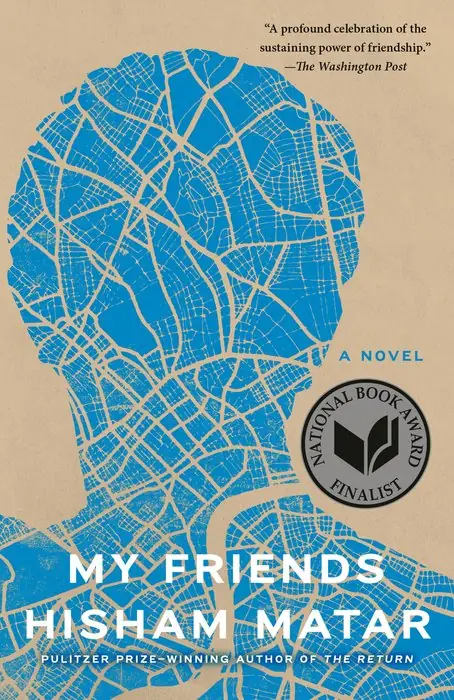
My Friends won the National Book Critics Circle Award for Fiction for 2024, presented on March 20, 2025 at the New School in New York. Fiction committee chair David Varno called it "a gripping and beautiful story of exile, literary obsession, and political intrigue" that "chronicles a Libyan man's three decades in London and the friendships he makes there while involuntarily estranged from his family and homeland." The finalists were Marie-Helene Bertino's Beautyland, Joseph O'Neill's Godwin, Percival Everett's James and Nora Lange's Us Fools. It won the 2024 Orwell Prize for Political Fiction, was longlisted for the 2024 Booker Prize, and was a finalist for the 2024 National Book Award.
Matar had been an NBCC fiction finalist before, for his first novel In the Country of Men, a finalist for 2007. Born in New York in 1970, he was a student in London in 1990 when his father, Jaballa Matar, was abducted in Cairo and delivered to Libya's Abu Salim prison; The Return, his 2016 memoir of searching for him, won the 2017 Pulitzer Prize for biography. Matar teaches at Barnard College and lives in London.
Where to get it
We may earn a commission if you buy through these links, at no extra cost to you.
Opens WorldCat, a catalogue of library holdings run by the nonprofit OCLC. We do not ask for or receive your location.