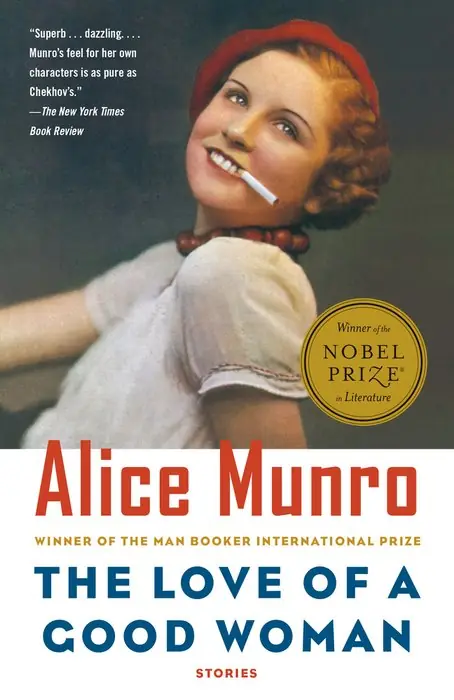
Summary
Alice Munro's ninth book holds eight long stories set in the Ontario towns and farms she had been writing about for decades. Five first ran in the New Yorker and one in Saturday Night, and together they run to some 340 pages of secrets, marriages, and the ordinary lives that hold them.
The title story is the longest and the one people argue about. It is told in four parts, Jutland, Heart Failure, Mistake, and Lies, and opens in the present with an optometrist's instrument case displayed in the museum of the town of Walley. In 1951 three boys, Cece, Jimmy, and Bud, playing by the river, find Mr. Willens's car sunk in the water with his body twisted inside it, and take most of a day to tell anyone. The story then leaves them for Enid, a practical nurse who has come to a farmhouse to see Mrs. Quinn through kidney failure. The patient is cold and spiteful, especially to her quiet husband Rupert, and before she dies she tells Enid what happened: that Rupert came in during an eye examination to find her skirt up and Willens's hand on her leg, and beat the man's head against the floor until he was dead, and that the two of them ran the car into the river. Enid is left holding the truth, her duty, and her own feelings about Rupert, and Munro carries her toward a decision and then declines to show it.
The other seven are nearly as full. In Cortes Island a bored young wife becomes the confidante of a stroke victim and may be embroidering what she learns about her odd landlords. Save the Reaper follows a grandmother whose impulsive moment puts her family in danger. The Children Stay tracks a young wife's adultery and what it costs. Before the Change has a daughter confront her father about the open secret of his life while keeping one of her own, and My Mother's Dream closes the book with a near fatal accident in a young mother's first summer, retold decades later by the daughter who survived it. Jakarta and Rich as Stink complete the set. Publishers Weekly praised the long, spare stories for laying bare the strata of the solitary life; Kirkus dissented, calling the collection overloaded with disclosures and the weakest of her books, while exempting the title story and Cortes Island. It suits patient readers.
Historical Context & Significance
The Love of a Good Woman won the National Book Critics Circle Award for Fiction for 1998, presented the following year, over Michael Cunningham's The Hours, David Gates's Preston Falls, Lorrie Moore's Birds of America, and Lynne Tillman's No Lease on Life. Munro is Canadian, and the book had already taken the 1998 Giller Prize at home against a shortlist that included Wayne Johnston's The Colony of Unrequited Dreams and Barbara Gowdy's The White Bone. McClelland and Stewart published it in Canada and Knopf in the United States in the fall of 1998.
The collection has held its place among her strongest. It was a 2004 Canada Reads contender, championed on air by the soprano Measha Brueggergosman, though the panel chose Guy Vanderhaeghe's The Last Crossing, and the title story is the one Kirkus, otherwise cool on the book, called a fine novella. Munro returned to the NBCC shortlist for 2001 with Hateship, Friendship, Courtship, Loveship, Marriage.
Where to get it
We may earn a commission if you buy through these links, at no extra cost to you.
Opens WorldCat, a catalogue of library holdings run by the nonprofit OCLC. We do not ask for or receive your location.