Summary
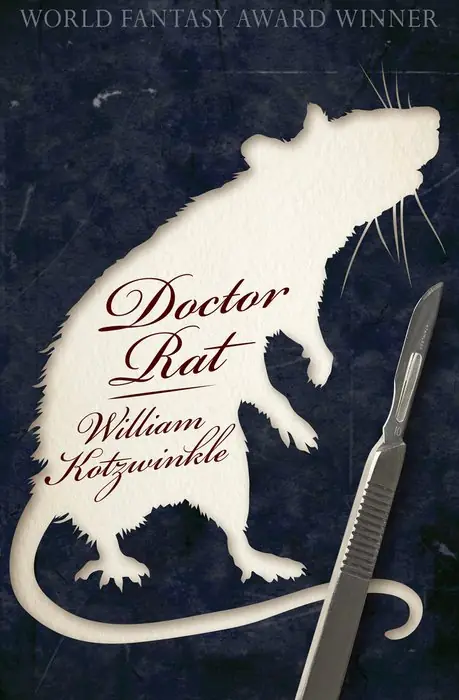
Doctor Rat is a laboratory rat who has been driven mad by the experiments performed on him and has decided to love them. He runs his mazes, sings songs in praise of the procedures, composes mock scientific papers in their defense, and argues for vivisection with the zeal of a convert, all for the sake of science, national defense and the next grant. Then a new subject arrives: a stray dog, brought in to test the effects of extreme heatstroke. The dogs have not been broken, and they start sending images of freedom to the other animals.
The rebellion spreads out of the laboratory and around the world. In chapters that leave Doctor Rat behind, the story moves among the other animals, chickens, pigs, dogs, whales and elephants included, each answering the call to gather as one animal against humankind; at one point an orchestral concert broadcast for the whales carries it further. Doctor Rat does all he can to stop it. The ending is bleak. People answer the uprising with the newest weapons they have and destroy the animals, and Doctor Rat, who calls this the final solution, is left feeling that it has somehow made the world lonely.
Kotzwinkle writes it as black comedy. Doctor Rat's voice, frantic, pompous and funny, carries most of the book, and the chapters given to the other animals are slower and more tender. It is not a book for the squeamish: the laboratory scenes are graphic, and the satire is blunt, with animals nearly always good and people nearly always cruel, a balance some readers find too simple. Kirkus enjoyed it, writing that it "teases your conscience with educated wit and versatile improvisation." It suits readers of Swift or Animal Farm who can take their satire with the lights on.
Historical Context & Significance
Doctor Rat won the World Fantasy Award for Best Novel in 1977. Knopf had published it in 1976. It beat a field that included John Steinbeck's The Acts of King Arthur and His Noble Knights, Karl Edward Wagner's Dark Crusade, Ramsey Campbell's The Doll Who Ate His Mother, Gordon R. Dickson's The Dragon and the George and Michael Moorcock's The Sailor on the Seas of Fate. Moorcock would win the award two years later with Gloriana.
Kotzwinkle's earlier books included The Fan Man (1974), the novel that led Steven Spielberg to ask him to write the novelization of E.T. the Extra-Terrestrial; published in 1982, it became the best selling novel of that year. He was a finalist for Best Novel again in 1997 with The Bear Went Over the Mountain, published in 1996. Doctor Rat has remained his one World Fantasy win.
Where to get it
We may earn a commission if you buy through these links, at no extra cost to you.
Opens WorldCat, a catalogue of library holdings run by the nonprofit OCLC. We do not ask for or receive your location.