Summary
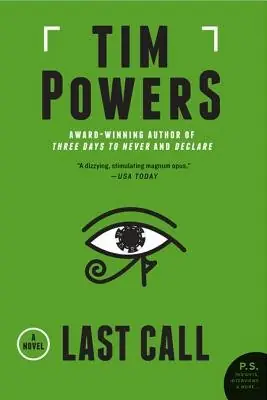
In 1969 Scott Crane, a young professional card player, sat down to a strange game of poker on a houseboat on Lake Mead, a game played with a Tarot deck and called Assumption. He thought he won. Twenty years later, around Easter 1989, he is a grieving widower troubled by nightmares of that night, and he learns that the game never ended. The man who ran it was his own father, Georges Leon, a gambler, mobster and occultist who killed Bugsy Siegel decades earlier to take over his operation and his place as the Fisher King, the wounded king of the Grail legend, here ruling from Las Vegas. Leon cheats death by stealing and possessing the bodies of the living. What Scott staked in 1969, without knowing it, was his own body and soul, and Leon means to collect.
Scott was raised not by Leon but by Ozzie Crane, an old professional gambler who took him in, alongside Diana, a girl Ozzie also raised, who is now a mother herself and a target too. With them, and with his loyal friend Arky Mavranos, who is sick with cancer and hoping for a cure, Scott heads back into the desert, pursued by Leon's people and by others who believe Scott will become the next Fisher King. Ozzie does not survive the journey. It ends with Scott playing Assumption against his father a second time. Afterward he takes up the crown himself and marries Diana, whose children he will raise as his own.
Powers works in the form known as secret history: he keeps every recorded fact about Siegel and the building of Las Vegas and supplies a hidden, magical reason behind it, with T. S. Eliot's The Waste Land running underneath. The book is long, dense and slow to explain its rules, and readers with no feeling for cards may find the poker hard going. Publishers Weekly called it "a difficult, but distinctive and commanding novel." Readers of Neil Gaiman's American Gods, which works a similar idea, will find here a Las Vegas nobody else has written.
Historical Context & Significance
Last Call won the World Fantasy Award for Best Novel in 1993, the first of Tim Powers's two wins in the category; the second came in 2001 for Declare. William Morrow had published it in 1992. The other finalists were Kim Newman's Anno Dracula, Jane Yolen's Briar Rose, Steve Szilagyi's Photographing Fairies and Geoff Ryman's Was. It also won the Locus Award for best fantasy novel, ahead of Lois McMaster Bujold's The Spirit Ring and Briar Rose, and it was a finalist for the Mythopoeic Award.
The novel opened what became the Fault Lines sequence. Expiration Date (1996) was itself a World Fantasy finalist, and Earthquake Weather (1997) follows on from both books. Powers, born in Buffalo, New York, in 1952, had made his name with The Anubis Gates, winner of the Philip K. Dick Award, and his On Stranger Tides was later partly adapted into the fourth Pirates of the Caribbean film. He has described his rule for this kind of book as never changing or disregarding any of the recorded facts.
Where to get it
We may earn a commission if you buy through these links, at no extra cost to you.
Opens WorldCat, a catalogue of library holdings run by the nonprofit OCLC. We do not ask for or receive your location.