Summary
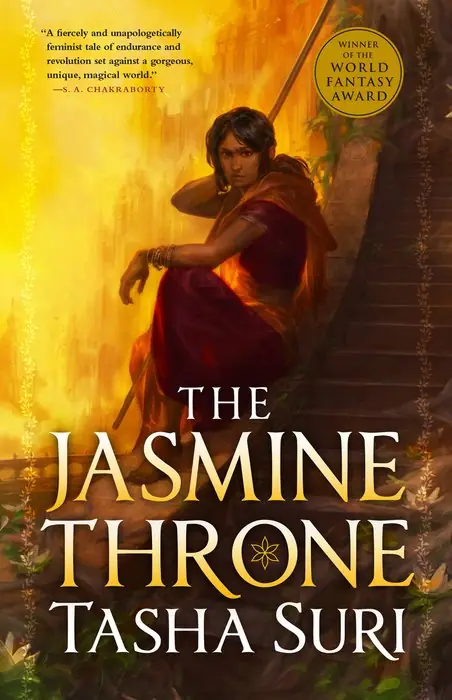
The Jasmine Throne is an epic fantasy inspired by the history of India, the first book of the Burning Kingdoms trilogy. The empire of Parijatdvipa rules the conquered land of Ahiranya, suppressing its language and its faith, and Ahiranya is dying of the rot, a plague that makes plants grow out of the bodies of the sick. When Emperor Chandra, a religious zealot, takes the throne, his sister Malini refuses to sacrifice herself for his throne. He sends her into exile, imprisoned in the Hirana, a temple in Ahiranya.
Priya is a servant in the household of the regent, General Vikram. She is also one of the few surviving temple children, and she has powers she keeps hidden. When she saves Malini from an assassin and becomes her attendant, the two women are drawn together, first as wary allies and then as lovers, each torn between the other and her own people. Around them move Priya's brother Ashok, who leads a violent resistance and wants the deathless waters within the temple for his fighters; Bhumika, the regent's wife and another surviving temple child, who has the regent executed and takes control of Ahiranya; and the princes plotting to replace Chandra. Priya and Bhumika pass through the deathless waters, Ashok dies trying, and the two women restore Ahiranya's old faith. Malini escapes, and at the end, when Chandra's soldiers come, she burns the temple of the nameless god, killing the soldiers, and is proclaimed empress.
This is a big, slow book, and the first chapters ask you to learn an empire, two religions and a large cast before the story takes hold. Readers who stay find a romance full of distrust and a hard look at what power costs the people who seize it. Publishers Weekly called it a "spellbinding epic fantasy" while warning that its magic and its cast take time to settle into. It suits readers of S. A. Chakraborty and Shelley Parker-Chan.
Historical Context & Significance
The Jasmine Throne won the World Fantasy Award for Best Novel in 2022, at the convention in New Orleans. The other finalists were Zen Cho's Black Water Sister, Aden Polydoros's The City Beautiful, Catriona Ward's The Last House on Needless Street and P. Djèlí Clark's A Master of Djinn. Orbit had published it in June 2021 in Britain and the United States. It was also a finalist for the British Fantasy Award for best fantasy novel, which went to Shelley Parker-Chan's She Who Became the Sun. At Tor.com, Liz Bourke called it "lush, evocative."
Suri was born in Harrow, London, to Punjabi parents, and worked as a librarian before writing full time. Her first novel, Empire of Sand, won the British Fantasy Awards' Sydney J. Bounds Award for best newcomer. The trilogy continued with The Oleander Sword in 2022 and The Lotus Empire in 2024, and the Burning Kingdoms was a Hugo finalist for best series in 2025.
Where to get it
We may earn a commission if you buy through these links, at no extra cost to you.
Opens WorldCat, a catalogue of library holdings run by the nonprofit OCLC. We do not ask for or receive your location.