Summary
Tender Morsels begins in St. Olafred's, a poor, preindustrial village, with a motherless girl named Liga whose father abuses her. By fifteen she has been made pregnant by him more than once, and after he dies a gang of village boys rapes her. With a baby daughter and another child on the way, Liga tries to end her life, and magic intervenes: she is given a heaven of her own, a gentle copy of her world where no one can hurt her.
There she raises two daughters, fair, obedient Branza and dark, restless Urdda, in a safety that is also a kind of sleep. But the walls of the heaven leak. A dwarf, a "littlee man" in Lanagan's words, slips in and out hunting treasure. A young man named Davit comes through in the shape of a bear and becomes the family's friend, and Liga falls in love with him. When the bear goes back, Urdda follows him out into the real world, where time runs at a different speed from her mother's heaven, and in the end finds a witch powerful enough to bring Liga and Branza through as well. The real world is as cruel to Liga as it ever was. Nor does the ending give her the romance a fairy tale would: Davit, far younger than Liga by then because the worlds have aged unevenly, marries Branza, and Liga's consolations are her daughters and a place among people at last.
Lanagan is retelling the Grimms' "Snow-White and Rose-Red," and she tells it in a dense, knotted village speech of her own invention that Publishers Weekly described as "thick, clotted prose that holds the reader to a slow pace." The opening chapters, with incest and rape, and later suggestions of bestiality, are very hard going, and although Kirkus reviewed it for readers fifteen and up, it suits older readers who can take them. Kirkus said the book "scintillates, titillates and altogether wows." Those who stay with it find a novel about how a person comes back from harm, and about why a world made safe is not enough to live in.
Historical Context & Significance
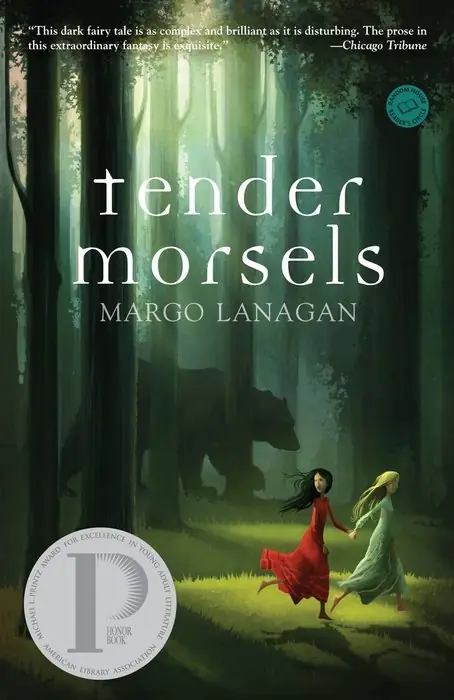
Tender Morsels shared the 2009 World Fantasy Award for Best Novel with Jeffrey Ford's The Shadow Year, ahead of Neil Gaiman's The Graveyard Book, Kage Baker's The House of the Stag and Daryl Gregory's Pandemonium. Allen and Unwin published it in Australia in 2008, and Knopf in the United States that October. It won Australia's Ditmar Award for best novel and was named a Michael L. Printz Honor Book in 2009, alongside Terry Pratchett's Nation. It was also a finalist for the Shirley Jackson Award, which went to The Shadow Year, and made the honor list of the James Tiptree Jr. Award.
Lanagan was born in Waratah, New South Wales, in 1960, and she had made her name with short fiction. Her collection Black Juice won two World Fantasy Awards in 2005, one for the book and one for its story "Singing My Sister Down," and was itself a Printz Honor Book. Her novella "Sea-Hearts" won the World Fantasy Award in 2010, and she expanded it into the novel Sea Hearts.
Where to get it
We may earn a commission if you buy through these links, at no extra cost to you.
Opens WorldCat, a catalogue of library holdings run by the nonprofit OCLC. We do not ask for or receive your location.