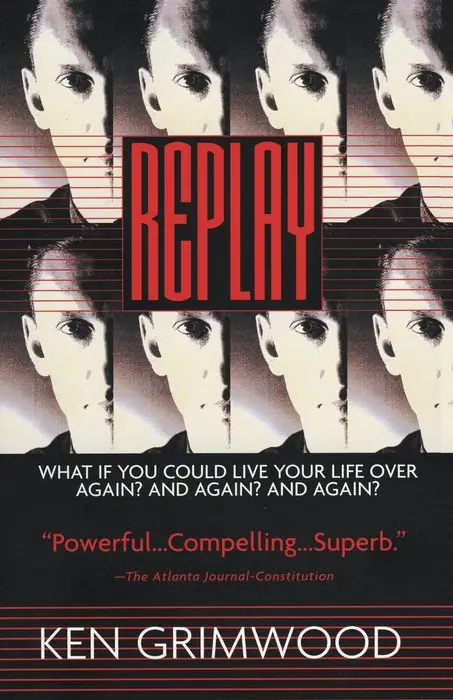
Summary
Jeff Winston is 43, a radio journalist, when he dies of a heart attack in 1988. He wakes up in 1963, eighteen years old, a student at Emory University in Atlanta, with every memory of the twenty five years he has just lived. He tries to stop the Kennedy assassination. He makes a fortune betting and investing on what he knows is coming. Then, at 43, he dies again in 1988 and wakes once more in the past, a little later each time.
So Replay becomes a novel of lives rather than a life. Jeff tries wealth, marriage to his college girlfriend, drugs and excess, each version of himself a different answer to the question of what a person would do with unlimited second chances. Then he sees a film called Starsea and realizes its maker, Pamela Phillips, must be replaying too. They find each other and fall in love, and they are not alone: a third replayer turns up, an institutionalized killer who believes aliens are forcing him to murder. When Jeff and Pamela go public with predictions of coming disasters, the government locks them up and exploits them. Meanwhile the cycles shrink, until Pamela wakes only hours before her own death. In the last cycle both survive their 1988 heart attacks and walk into a future neither has seen, and an epilogue suggests they were never the only ones.
The premise does most of the work, and it is a very good premise. The book reads quickly and is built in episodes, one life at a time, which Kirkus disliked, calling it "a numbingly episodic novel." Rereading it in 2025, Ian Sales found it "a fun, if a little mawkish, read" and its ending a letdown. Readers who enjoy what if stories, or who have watched a film about a repeating day and wanted the long version, will find it hard to put down.
Historical Context & Significance
Replay won the World Fantasy Award for Best Novel in 1988, against a strong and varied field: John Crowley's Ægypt, Stephen King's Misery, Tim Powers's On Stranger Tides, Orson Scott Card's Seventh Son, Robert R. McCammon's Swan Song and Clive Barker's Weaveworld. Arbor House had published it. It was also shortlisted for the 1988 Arthur C. Clarke Award, which went to George Turner's The Sea and Summer, and it became a bestseller in Japan.
Grimwood, born in Dothan, Alabama, in 1944, had worked in radio news, as an editor at KFWB in Los Angeles among other posts, and had published several novels before this one. Hollywood has returned to it repeatedly: Warner Bros. announced a film in 2010 with Ben Affleck attached, then Robert Zemeckis, then Greg Berlanti, and none of those versions has been released. Grimwood was working on a sequel when he died of a heart attack in Santa Barbara in June 2003, aged 59.
Where to get it
We may earn a commission if you buy through these links, at no extra cost to you.
Opens WorldCat, a catalogue of library holdings run by the nonprofit OCLC. We do not ask for or receive your location.