Summary
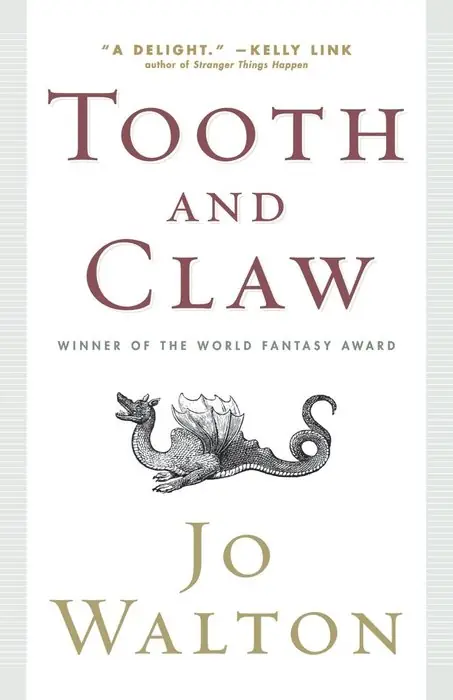
Tooth and Claw is a Victorian novel of manners in which every character is a dragon. Jo Walton took her model from Anthony Trollope's Framley Parsonage and built a society that runs on its logic: dragons grow by eating the flesh of other dragons, the weak and the dead are food, and a maiden's golden scales turn pink when an unrelated male touches her, a visible sign that she is spoken for.
The story opens at the deathbed of Bon Agornin, a dragon of humble origins who has risen in the world. His five children gather: Penn, a parson; Avan, the younger son; Berend, married to the powerful Illustrious Daverak; and the two unmarried daughters, Haner and Selendra. By custom the family eats the body, and Daverak takes far more than his share. Avan goes to law to get it back. Bon also makes a deathbed confession to Penn, who absolves him, which puts the parson in a difficult position with his church. The sisters are separated, Haner going to live with Daverak and Selendra with Penn, and Frelt, a priest who works with Penn, asks Selendra to marry him; she refuses, but his advances turn her scales pink all the same. In the end Sher Benandi fights Daverak to the death, the Agornins get both his wealth and his body, Avan wins his case, and Selendra marries Sher.
Walton tells it through an omniscient narrator with a Victorian voice, full of propriety and dry wit, and the joke never quite stops being a joke: the dragons worry about propriety and inheritance while eating each other. It is also a clear eyed look at class and at the constraints on women in the society Trollope wrote about. The pace is leisurely, which suits some readers and tries others. It suits readers of Trollope, Austen or Gaskell, and fantasy readers who want something without a quest or a war.
Historical Context & Significance
Tooth and Claw won the World Fantasy Award for Best Novel in 2004. Tor had published it in November 2003. The finalists it beat were K. J. Bishop's The Etched City, Kij Johnson's Fudoki, Ian R. MacLeod's The Light Ages and Jeff VanderMeer's Veniss Underground. Reviewers split sharply. Publishers Weekly called it "enthralling" and "provocative," while Kirkus dismissed it: "Silly when not plain dull: a mediocre soap with bloody trappings."
Walton was born in Aberdare, Wales, in 1964, and moved to Montreal in 2002. She had won the John W. Campbell Award for best new writer in 2002, after her first novel, The King's Peace (2000). She went on to the Farthing novels (2006 to 2008) and to Among Others (2011), which won both the Hugo and the Nebula Award for Best Novel. In 2011 she also wrote a critical reread of Le Guin's The Other Wind, the 2002 winner, for Tor.com.
Where to get it
We may earn a commission if you buy through these links, at no extra cost to you.
Opens WorldCat, a catalogue of library holdings run by the nonprofit OCLC. We do not ask for or receive your location.