Summary
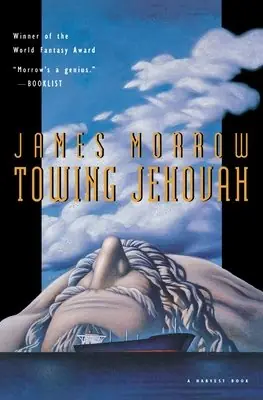
God is dead, and His body, two miles long, is floating in the Atlantic off the coast of Africa. Anthony Van Horne, a sea captain still haunted by the supertanker he once ran onto a reef, causing a vast oil spill, meets the dying archangel Raphael at the Cloisters in New York. Raphael has a job for him: tow the corpse north and entomb it in the Arctic ice, where the cold will preserve it. The Vatican is behind the voyage, and in return Van Horne gets back his old ship, the Carpco Valparaiso, now flying Vatican colors, and a chance to atone.
Everything goes wrong at sea. Aboard is Cassie Fowler, a scientist and militant atheist who believes the body's very existence threatens the feminist cause. Once the crew realizes that God is no longer watching, discipline gives way to depravity and then to mutiny. An island rises out of the sea and grounds the tanker, and mutineers desert for an ancient temple. Van Horne, arguing with himself in the pages of his notebook, restores order, and the crew dig the ship free. Then militant atheists who cannot bear the evidence hire a World War II reenactment society to attack the cargo with dive bombers and torpedo planes, in what becomes the Second Battle of Midway. When supplies run out the starving crew are reduced to eating the divine corpse, and at last the body is laid to rest in an iceberg.
Morrow writes broad philosophical satire, and the book is funny, crowded and long. Readers have always split over whether the jokes add up to anything. Kirkus found it "witty, entertaining, and provocative" but said "the plot makes little sense," and that Morrow makes no serious attempt to grapple with the questions he raises. Other readers have found the long voyage dull in stretches. It suits readers who enjoy Kurt Vonnegut, or anyone who wants a novel that takes the death of God literally and follows the consequences all the way to the ice.
Historical Context & Significance
Towing Jehovah won the World Fantasy Award for Best Novel in 1995, Morrow's second win in the category after Only Begotten Daughter shared it in 1991. Harcourt Brace had published it in 1994. It beat Michael Bishop's Brittle Innings, Brooke Stevens's The Circus of the Earth and the Air, Jonathan Carroll's From the Teeth of Angels, John Crowley's Love & Sleep and Elizabeth Hand's Waking the Moon.
The novel was also a finalist for the Hugo Award, which went to Lois McMaster Bujold's Mirror Dance, for the Nebula, won by Greg Bear's Moving Mars, and for the Arthur C. Clarke Award, and it finished second to Brittle Innings in the Locus poll for fantasy novel. Looking back at that Hugo ballot in 2011, Jo Walton called it "brilliant but weird" and a "terrific nominee" she would have been happy to see win. The French translation won the Grand Prix de l'Imaginaire in 1996. The book opened Morrow's Godhead trilogy, continued in Blameless in Abaddon (1996) and The Eternal Footman (1999). Morrow, born in Philadelphia in 1947, later wrote The Last Witchfinder (2006).
Where to get it
We may earn a commission if you buy through these links, at no extra cost to you.
Opens WorldCat, a catalogue of library holdings run by the nonprofit OCLC. We do not ask for or receive your location.