Summary
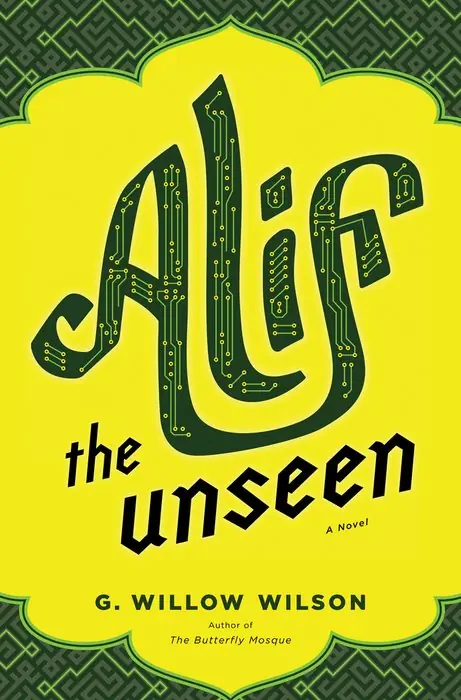
Alif is only a handle. Its owner is a young hacker, part Arab and part Indian, in the City, the capital of an unnamed emirate on the Persian Gulf, and from his room he sells protection from state surveillance to anyone who needs it: Islamists, communists, feminists. When Intisar, the wealthy girl he loves, breaks off their affair without explanation and he learns she is to marry a man her family has chosen, Alif writes a program, Tin Sari, to keep her from ever seeing him online. Her fiancé turns out to be the Hand, a prince who hunts dissidents through their computers, and soon afterward the Hand breaks into Alif's.
Alif runs. He takes with him Dina, the pious neighbor he has known since childhood and whose face he has not seen in the ten years since she took the veil, and a strange old book Intisar has sent him: the Alf Yeom, The Thousand and One Days, a collection of tales said to be told by the jinn. Their flight leads them to Vikram the Vampire, a handsome underworld fixer whose knees, glimpsed from the corner of the eye, bend the wrong way, and into the hidden world of the jinn; to an American convert who knows antique books; and to a mosque where they shelter from the police. Alif tries to use the Alf Yeom to build a quantum computer, is captured and interrogated, and is freed months later by a hacker called NewQuarter01. In the climax, amid internet blackouts and riots in the City, the Hand is lynched by the crowd and Alif and Dina escape.
Wilson mixes computer code, Islamic theology and the tradition of the Thousand and One Nights, and the mix is the book's charm. It is long and busy, though. Kirkus admired an ambition it likened to Neil Gaiman's but found the tale plodding and "overstuffed with left turns," and readers without patience for technical talk may skim. In Salon, Laura Miller was reminded of "the energetic plotting of Philip Pullman, the nimble imagery of Neil Gaiman and the intellectual ambition of Neal Stephenson." It suits readers of those three, and anyone who wants a fantasy set in the Arab world and written with real care for its faith.
Historical Context & Significance
Alif the Unseen won the 2013 World Fantasy Award for Best Novel, presented at the convention in Brighton, England. The other finalists were Anna Tambour's Crandolin, Caitlín R. Kiernan's The Drowning Girl, N. K. Jemisin's The Killing Moon and Graham Joyce's Some Kind of Fairy Tale. It was Wilson's first novel, published in 2012 by Grove in the United States and Corvus in Britain, and it came out as the Arab Spring was unfolding, a timeliness Kirkus remarked on. It was longlisted for the 2013 Women's Prize for Fiction, came second in the Locus poll for first novel and tied for third place for the John W. Campbell Memorial Award.
Wilson was born in New Jersey in 1982 and converted to Islam in 2003, on her way to Cairo. She began in comics, with the graphic novel Cairo in 2007 and the series Air. Soon after this novel she helped create Kamala Khan, the teenage Pakistani American Ms. Marvel, whose first collected volume won the 2015 Hugo Award for Best Graphic Story, and she later wrote Wonder Woman for DC.
Where to get it
We may earn a commission if you buy through these links, at no extra cost to you.
Opens WorldCat, a catalogue of library holdings run by the nonprofit OCLC. We do not ask for or receive your location.