Summary
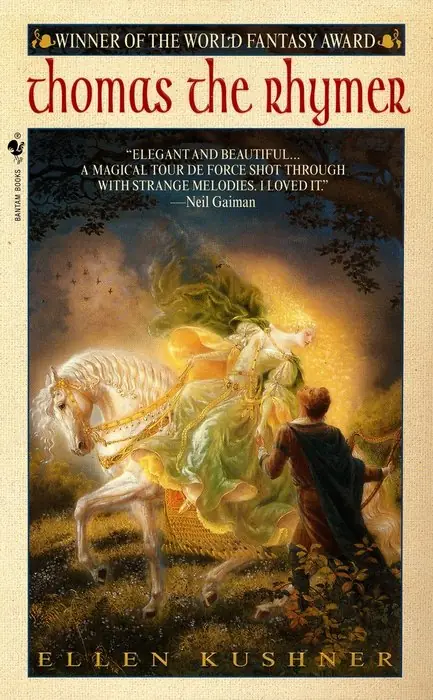
Thomas the Rhymer is Ellen Kushner's novel of the old Scottish ballad about a thirteenth century minstrel carried off by the Queen of Elfland. Her Thomas is a harper, carefree, charming and very pleased with himself. He turns up at the croft of an elderly couple, Gavin and Meg, charms them with stories of the court and his conquests, and makes himself a kind of son to them. He also starts courting their young neighbor, Elspeth. Then he vanishes.
The Queen of Elfland has taken him as her lover, and he serves her for seven years without aging, under strict conditions: he may speak only to her and eat only what she gives him. She is beautiful and whimsical, and she can be merciless. He wins a contest of riddles against her brother, Hunter, and when she releases him she sends him home with gifts of prophecy and a tongue that cannot lie. Back in the human world he has to relearn his art and find his way back to Elspeth, whose hard years without him have made her wary, and the compulsion to tell the truth makes everything harder. They marry, and the book follows them to the end of Thomas's life, with a final turn that changes how the whole story looks.
Kushner gives each of the four parts a different narrator, speaking in the first person: Gavin, then Thomas himself in Elfland, then Meg, and finally Elspeth. The first part is written in a rustic voice that the reviewer Russ Allbery found a little awkward, but the book warms as it goes, and he singled out the ending, whose final five paragraphs make a reader rethink every relationship in the book. Reviewers split sharply. Publishers Weekly praised "a happy blend of discreet scholarship and literary style," while Kirkus found it "drab and unmagical." It suits readers who love ballads and fairy tales, and anyone who prefers a quiet, intimate fantasy to an epic one.
Historical Context & Significance
Thomas the Rhymer shared the World Fantasy Award for Best Novel in 1991 with James Morrow's Only Begotten Daughter; both had been published by William Morrow the year before. The other finalists were Good Omens by Terry Pratchett and Neil Gaiman, Valerie Martin's Mary Reilly and Guy Gavriel Kay's Tigana. The book also won the 1991 Mythopoeic Fantasy Award, over Tigana, Ursula K. Le Guin's Tehanu and Only Begotten Daughter, and in 2009 a Finnish translation won the Tähtifantasia Award for the best foreign fantasy novel published in Finland.
It was Kushner's second novel, after Swordspoint (1987), the first of her Riverside books. Born in 1955, she spent years in public radio, hosting the program Sound and Spirit from 1996 to 2010, and she helped found the Interstitial Arts Foundation. Gollancz published it in London in 1991, and later editions came from Tor and Bantam Spectra. She lives in New York City with her wife, the writer Delia Sherman.
Where to get it
We may earn a commission if you buy through these links, at no extra cost to you.
Opens WorldCat, a catalogue of library holdings run by the nonprofit OCLC. We do not ask for or receive your location.