Summary
Coleman Silk is a classics professor and former dean of faculty at Athena College, in western Massachusetts. He calls two students who have never shown up to his class "spooks." The students turn out to be Black, the word is heard as a racial slur, and the charge of racism ends his career. His wife, Iris, dies of a stroke that he blames on the fight, and he becomes estranged from his children. Nathan Zuckerman, Roth's recurring novelist narrator, now sixty five, hears the story when Silk asks him for help writing about it. The novel is set in 1998, the year of the Clinton impeachment, and Roth sets Silk's disgrace against the national mood of moral persecution.
What Zuckerman learns only from Silk's sister, Ernestine, and then reconstructs, is that Coleman Silk is a light skinned Black man from East Orange, New Jersey, who has passed as white since he enlisted in the Navy during the Second World War and gave his race as white. After the war came NYU, Greenwich Village and marriage to Iris, a nonreligious Jewish woman, and his children never knew. In the present he begins an affair with Faunia Farley, thirty four, a janitor at the college whom everyone believes cannot read, though she can. Her former husband, Les, is a violent Vietnam veteran with post traumatic stress disorder, and Delphine Roux, a young French academic at Athena, makes herself Silk's enemy. In November Silk and Faunia die in a car crash that Zuckerman suspects Les caused. Ernestine tells Zuckerman the truth at the funeral, and the novel ends with Zuckerman face to face with Les.
This is a long novel of long sentences and longer digressions, and much of Silk's past is Zuckerman's reconstruction. Kirkus called it "a marvel of imaginative empathy, generosity, and tact," and the New York Times, naming it an Editors' Choice, said that when Zuckerman and Silk are together "Roth's writing reaches an emotional intensity and a vividness not exceeded in any of his books." It suits readers who want a large novel about race, reputation and the American habit of starting over, told by a narrator who openly imagines much of what he cannot know.
Historical Context & Significance
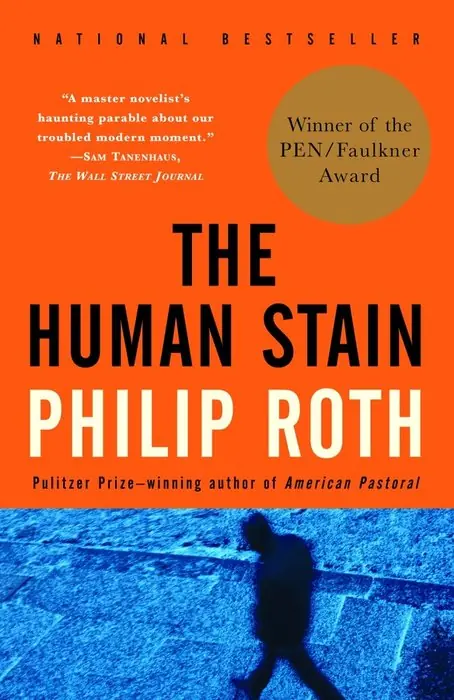
The Human Stain won the PEN/Faulkner Award for Fiction in 2001, Roth's second win after Operation Shylock in 1994; Everyman made it three in 2007. The other finalists were Michael Chabon's The Amazing Adventures of Kavalier and Clay, that year's Pulitzer winner, Millicent Dillon's Harry Gold, Denis Johnson's The Name of the World and Mona Simpson's Off Keck Road. It completes Roth's American trilogy, after American Pastoral (1997), which won the 1998 Pulitzer, and I Married a Communist (1998). It won Britain's WH Smith Literary Award in 2001 and France's Prix Médicis étranger in 2002.
Reviewers including Michiko Kakutani and Lorrie Moore saw a resemblance between Silk and the critic Anatole Broyard, who had been revealed after his death to have passed as white. In an open letter in the New Yorker in 2012 Roth denied it and named his late friend Melvin Tumin, a Princeton sociologist accused over a remark about Black students, as the source. Robert Benton directed the 2003 film, with Anthony Hopkins and Nicole Kidman. In 2024 the New York Times placed the novel on its list of the hundred best books of the century.
Where to get it
We may earn a commission if you buy through these links, at no extra cost to you.
Opens WorldCat, a catalogue of library holdings run by the nonprofit OCLC. We do not ask for or receive your location.