Summary
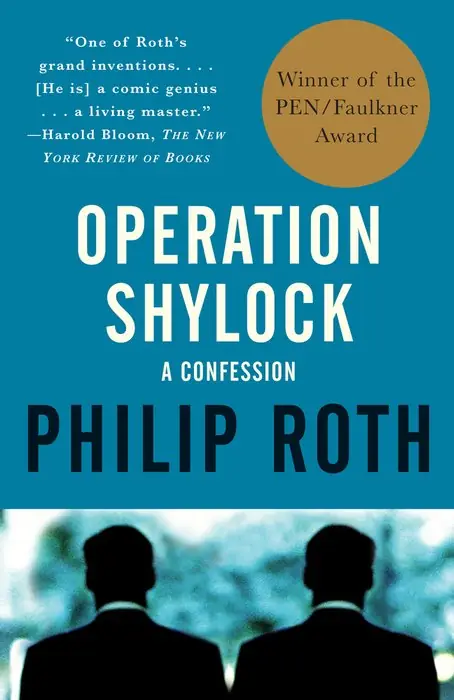
Operation Shylock, subtitled A Confession, is narrated by a novelist named Philip Roth, a Jewish American writer in his fifties who is recovering from a breakdown brought on by the sleeping pill Halcion when he learns that a man in Jerusalem is using his name. He travels to Israel, partly to interview the novelist Aharon Appelfeld, and finds the impostor, who looks exactly like him and whom he takes to calling Moishe Pipik. Pipik is promoting Diasporism, a plan for Ashkenazi Jews to leave Israel and resettle in the European countries their families came from, in order to prevent a second Holocaust. He is a former detective, dying of cancer, and his companion is Jinx Possesski, his former nurse, who describes herself as a recovering anti-Semite. Philip becomes involved with her.
All of this unfolds against the Jerusalem trial of John Demjanjuk, an Ohio mechanic born in Ukraine who is accused of being Ivan the Terrible, a guard at Treblinka. George Ziad, a friend from Philip's college years who is now committed to the Palestinian cause in Ramallah, takes him for the Diasporist and tries to connect him with the PLO, and Philip accidentally accepts a million dollar check for the movement. Louis B. Smilesburger, a Mossad agent on crutches, then kidnaps him and presses him into an intelligence operation. The book does not show that operation. In place of a final chapter, an epilogue explains that the account was cut at the request of Israeli intelligence, and a closing note to the reader declares the whole book fiction, a note Roth insisted the Mossad had asked him to add.
The novel runs to about four hundred pages and much of it is argument: long speeches about Israel, the Diaspora, the Holocaust and who has the right to a name. John Updike, in the New Yorker, called it "an orgy of argumentation." It is also very funny, and Kirkus judged that "rarely have fact and fiction, personal confession and wild imaginings, led such a deeply, unnervingly comic dance." Readers who enjoy Roth arguing with himself will find him at full volume here; readers new to him might start elsewhere.
Historical Context & Significance
Operation Shylock won the PEN/Faulkner Award for Fiction in 1994, over Stanley Elkin's Van Gogh's Room at Arles, Dagoberto Gilb's The Magic of Blood, Fae Myenne Ng's Bone and Kate Wheeler's Not Where I Started From. It was the first of Roth's three wins, followed by The Human Stain in 2001 and Everyman in 2007, and no other writer has won three times. The book was also a Pulitzer finalist in 1994, the year Annie Proulx won for The Shipping News. Simon and Schuster published it on April 8, 1993.
The first reviews were mixed. D. M. Thomas, in the New York Times Book Review, called it "an impassioned quarrel," and Paul Gray in Time found it "a lot of fun," while Updike likened it to Hamlet, "which also has too many characters, numerous long speeches, and a vacillating, maddening hero." Roth told the New York Times in March 1993 that "the book is true." Its standing rose over time: several writers named it when the New York Times Book Review surveyed the best American fiction of the previous twenty five years in 2006. Roth died in 2018.
Where to get it
We may earn a commission if you buy through these links, at no extra cost to you.
Opens WorldCat, a catalogue of library holdings run by the nonprofit OCLC. We do not ask for or receive your location.