Summary
The Buddha in the Attic follows a generation of young Japanese women who cross the Pacific early in the twentieth century as picture brides, bound for California to marry men they know only from letters and photographs. Julie Otsuka tells their story in the first person plural, a "we" that speaks for all of them, and she gives the book no continuing heroine. Instead of following one bride, each short chapter heaps up the experiences of many, one woman's fate after another's. There are eight chapters, and their titles trace the arc: "Come, Japanese!", "First Night", "Whites", "Babies", "Children", "Traitors", "Last Day" and "A Disappearance."
The hard voyage binds the women together in hope. San Francisco ends it: the husbands waiting for them are seldom the men of the letters and photographs, and the first nights are often brutal. Then comes work, as laborers in the fields of California and as maids in white households, with English learned in scraps and hostility from white neighbors. The women give birth with little help and go back to the fields with their babies, and those children grow up American, take American names and drift away from their parents' language. When war comes, rumors spread of names on a list, husbands disappear, and at last the evacuation notices go up and whole families leave their homes for the camps. In the final chapter the voice changes hands: the "we" becomes the white townspeople left behind, who miss their Japanese neighbors for a while and then forget them.
The book is short, the length of a novella, and can be read in an evening, but the chorus asks something of the reader. There is no single life to follow, only an accumulation of lives, and readers who want one character to live with may find the litany distancing. Those who give in to its rhythm find it hard to shake. Alida Becker in the New York Times wrote that "Otsuka's incantatory style pulls her prose close to poetry," and Kirkus ended its review by calling the book "a lovely prose poem that gives a bitter history lesson." It suits readers who want the history of Japanese American internment felt rather than explained.
Historical Context & Significance
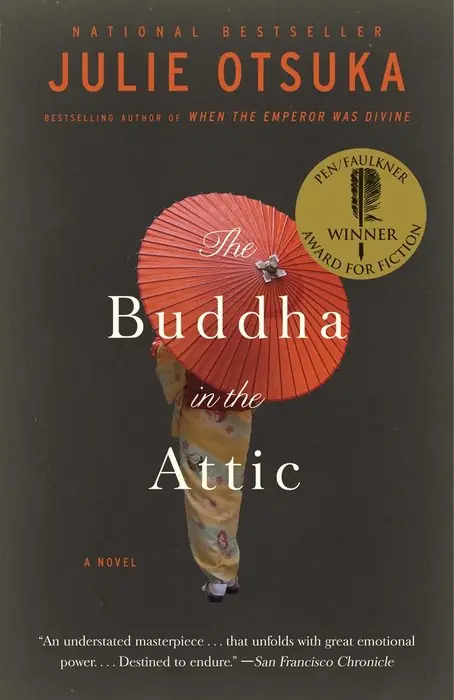
The Buddha in the Attic won the 2012 PEN/Faulkner Award for Fiction, announced on March 26, 2012. The judges, Marita Golden, Maureen Howard and Steve Yarbrough, chose it from more than 350 books published in 2011, and the finalists were Russell Banks's Lost Memory of Skin, Don DeLillo's The Angel Esmeralda: Nine Stories, Anita Desai's The Artist of Disappearance and Steven Millhauser's We Others: New and Selected Stories. The winner received $15,000 and each finalist $5,000, and all five were honored at the Folger Shakespeare Library in Washington on May 5, 2012. The novel had already been a finalist for the 2011 National Book Award, which went to Jesmyn Ward's Salvage the Bones, and in France, translated as Certaines n'avaient jamais vu la mer, it won the 2012 Prix Femina étranger.
Otsuka was born in Palo Alto, California, in 1962. Her mother was nisei, and her mother's family was held at the Tanforan racetrack and then at the Topaz camp in Utah during the war. The Buddha in the Attic was her second novel, after When the Emperor Was Divine (2002); her third, The Swimmers (2022), won the Andrew Carnegie Medal for Excellence in Fiction in 2023.
Where to get it
We may earn a commission if you buy through these links, at no extra cost to you.
Opens WorldCat, a catalogue of library holdings run by the nonprofit OCLC. We do not ask for or receive your location.