Summary
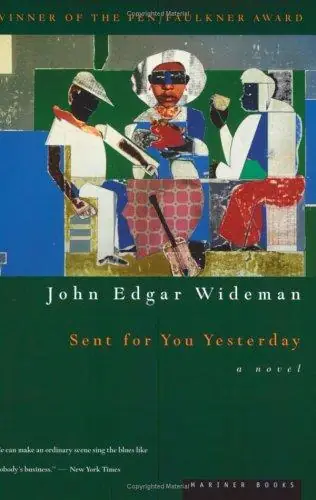
Sent for You Yesterday is the third of John Edgar Wideman's books about Homewood, the Black neighborhood in the East End of Pittsburgh where he grew up, after Damballah and Hiding Place. It stands on its own. The narrator, Doot, comes back to Homewood to hear his Uncle Carl French and Lucy Tate tell the stories of their lives, and the novel runs from the migrations north in the 1930s to 1970.
At its center is Albert Wilkes, a jazz pianist who kills a white policeman and flees. Seven years later, still before the Second World War, he comes home, and he is betrayed and killed. His memory shapes everyone who grew up in his shadow, above all the trio at the heart of the book: Lucy, Carl, her lover of many years, and Lucy's adoptive brother, known only as Brother Tate. Brother is an albino, a gifted musician and artist who speaks less and less. When his son Junebug dies in a fire on the Fourth of July, Brother stops talking altogether, and sixteen years later he dies under an oncoming train. Lucy tells Doot why she has never married Carl: he lacks the strength she saw in the older generation, in John and Freeda French and even in Albert Wilkes.
The telling does not run in order. Voices overlap, stories break off and resume from another angle, and the book feels at times like a set of linked stories, which asks work of the reader. Kirkus heard too much Faulkner in it and found it talky, but granted that the novel is "ambitious, earnest, and passionate" and that readers willing to work would be moved. The music of the talk, and the sense of a whole neighborhood remembering together, are what stay with you. It suits readers of Toni Morrison, and anyone who wants the history of a Black neighborhood told from inside it.
Historical Context & Significance
Sent for You Yesterday won the PEN/Faulkner Award for Fiction in 1984, and it won as a paperback original: Avon had published it in 1983 as a mass market paperback, Allison and Busby published it in London in 1984, and Schocken brought out an American hardcover in 1985. The finalists it beat included William Kennedy's Ironweed, winner of the 1984 Pulitzer Prize for Fiction, along with Ron Hansen's The Assassination of Jesse James by the Coward Robert Ford, Jamaica Kincaid's At the Bottom of the River, Bernard Malamud's The Stories and Cynthia Ozick's The Cannibal Galaxy.
Wideman, born in Washington, D.C., in 1941 and raised in Homewood, had been a Rhodes Scholar in 1963. The University of Pittsburgh Press collected the three in 1992 as The Homewood Books. When he won the prize in 1984, Wideman was a professor of English at the University of Wyoming in Laramie. In 1991 he won the PEN/Faulkner Award a second time, for Philadelphia Fire, and in 1993 he received a MacArthur Fellowship.
Where to get it
We may earn a commission if you buy through these links, at no extra cost to you.
Opens WorldCat, a catalogue of library holdings run by the nonprofit OCLC. We do not ask for or receive your location.