Summary
In May 1985 Philadelphia police dropped explosives onto the roof of a West Philadelphia house occupied by MOVE, an Afrocentric organization, and the fire that followed killed eleven people, five of them children, and destroyed dozens of homes. Philadelphia Fire begins in the aftermath. Cudjoe, a Black writer who has spent ten years in exile on a Greek island, tending bar on Mykonos, comes home to Philadelphia because he has heard that a boy, Simba, ran out of the burning house alive. He means to find the child and write the book of what happened, and he goes looking among former MOVE members, city officials and neighbors, and through Margaret Jones, who knew the household and is his one real link to the boy.
The search pulls Cudjoe back into his own past as well: the white wife and children he walked out on, a novel that failed, a mentor who has died, and a production of Shakespeare's The Tempest that he once planned to stage in a park. Then, in the second of the book's three parts, the fiction breaks open and Wideman speaks in his own voice, about writing, about the city, and about his son, who is in prison for murder. The last and shortest part moves among fast alternating voices; its central figure is J.B., a homeless, educated man in Center City who is haunted by visions of genocide and whom a gang of youths sets on fire. Cudjoe never finds the boy. He attends a vigil for the dead, and the novel leaves him in Independence Square, hearing "a mob howling his name" behind him and turning to face it.
This is a short book, about two hundred pages, and a demanding one: fragmented, out of chronological order, and more interested in grief and anger than in answers. Publishers Weekly called the prose "incantatory, lyrical, naturalistic and inventive." The novelist Charles Johnson, reviewing it in the Washington Post, found "a book brimming over with brutal, emotional honesty" but warned that it was no page turner, and Kirkus warned that "this metafiction will disturb as many readers as it dazzles." It suits readers ready to follow a writer thinking aloud about a city and a family.
Historical Context & Significance
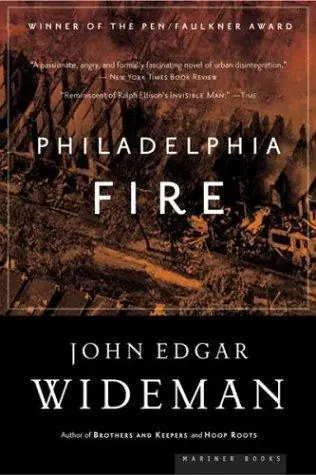
Philadelphia Fire won the PEN/Faulkner Award for Fiction in 1991. The other finalists were Paul Auster's The Music of Chance, Joanne Meschery's A Gentleman's Guide to the Frontier, Steven Millhauser's The Barnum Museum and Joanna Scott's Arrogance. Wideman had won in 1984 for Sent for You Yesterday, which made him the first writer to take the prize twice; E. L. Doctorow and Ha Jin later matched him, and only Philip Roth has won more often. The novel also received a 1991 American Book Award. Henry Holt published it in the fall of 1990.
Wideman, born in Washington, D.C., in 1941, was a Rhodes Scholar and was teaching at the University of Massachusetts Amherst when the book appeared. His son Jacob had killed a fellow camper in 1986 and pleaded guilty to murder in 1988. He received a MacArthur fellowship in 1993, moved to Brown University in 2004, and won the Prix Femina étranger in 2017 and the PEN/Malamud Award in 2019.
Where to get it
We may earn a commission if you buy through these links, at no extra cost to you.
Opens WorldCat, a catalogue of library holdings run by the nonprofit OCLC. We do not ask for or receive your location.