Summary
Mao II opens at Yankee Stadium, where Karen Janney, twenty one, is married to a man she has only just met in a mass wedding of the Unification Church while her parents watch her disappear into the crowd. The novel then turns to Bill Gray, a reclusive novelist who published two celebrated books long ago and has spent years in upstate New York working on a third that he will not let himself finish. His assistant, Scott Martineau, runs the house and keeps the archive; Karen, out of the church now, lives there with Scott. Bill agrees to sit for Brita Nilsson, a Swedish photographer making a series of portraits of writers, and the sitting draws him back toward the world. He has come to believe that terrorists now hold the ground novelists once did, and when his editor and friend Charles Everson asks him to appear in London at an event for Jean-Claude Julien, a Swiss poet held hostage in Beirut, he goes.
Bomb threats force the London event to move. George Haddad, an academic in Athens acting as a go between with the group holding Julien, suggests that Bill go to Beirut himself. Bill slips away from everyone who knows him. On Cyprus he is struck by a car, and he dies of internal injuries on the ferry to Lebanon; a stranger takes his papers. In New York, Scott and Karen come to accept that he may not return and decide to let the unfinished manuscript sit in the house. In the epilogue Brita, no longer photographing writers, is in Beirut to photograph Abu Rashid, the man behind the kidnapping. Julien's fate is never told, and the book closes on a wedding party moving through the ruined city under the escort of a tank.
The novel is short, around 250 pages, and Publishers Weekly called it "dense but accessible." Much of it is talk, about crowds, fame, photographs and terror, and readers who want plot may find Bill's long arguments heavy going. What carries it is the prose: Lorrie Moore, in the New York Times, wrote that "no one's prose is better than Mr. DeLillo's," and Kirkus called it "a luminous book, full of anger deflected into irony." It suits readers who liked White Noise or Libra.
Historical Context & Significance
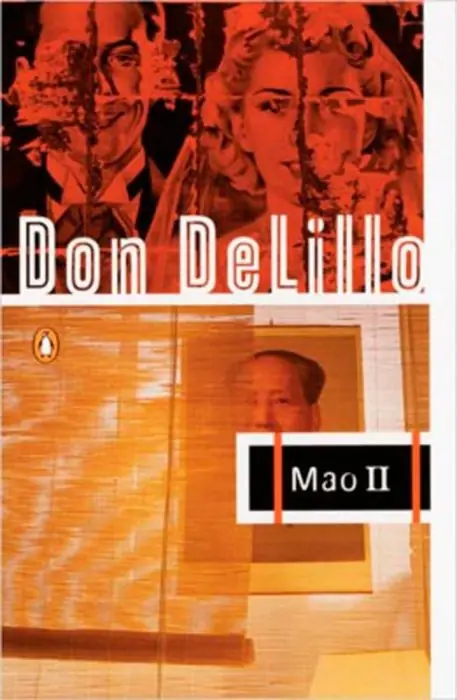
Mao II won the PEN/Faulkner Award for Fiction in 1992, over Stephen Dixon's Frog, Paul Gervais's Extraordinary People, Allan Gurganus's White People and Bradford Morrow's The Almanac Branch. It was also a finalist for the 1992 Pulitzer Prize, which went to Jane Smiley's A Thousand Acres. Viking published it in June 1991 as DeLillo's tenth novel. The title comes from Andy Warhol's silkscreens of Mao Zedong, and DeLillo cited a published photograph of J. D. Salinger and a photograph of a Unification Church wedding as starting points. It appeared two years after the fatwa against Salman Rushdie.
Reviewers split. Sven Birkerts, in the Washington Post, called it "DeLillo's strongest statement yet about the crisis of crises," while John Lanchester, in the London Review of Books, found its central argument, that what terrorists gain novelists lose, too schematic. His Underworld was a Pulitzer finalist in 1998, and he returned to the PEN/Faulkner shortlist in 2012 with the stories of The Angel Esmeralda.
Where to get it
We may earn a commission if you buy through these links, at no extra cost to you.
Opens WorldCat, a catalogue of library holdings run by the nonprofit OCLC. We do not ask for or receive your location.