Summary
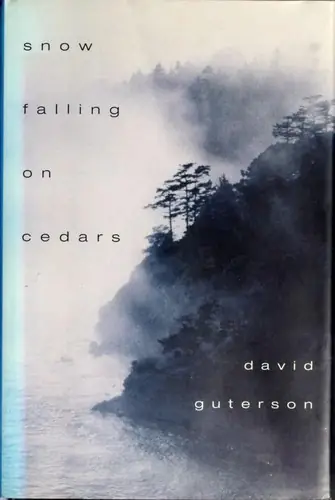
In 1954, on San Piedro, a fictional island off the coast of Washington State, Kabuo Miyamoto, a fisherman of Japanese descent, goes on trial for the murder of Carl Heine, a fellow fisherman found dead in his own net with his watch stopped at 1:47. Snow falls on the island through the trial. The case turns on land. Before the war Kabuo's family had nearly finished paying for seven acres from the Heine family; after Pearl Harbor the Miyamotos were interned, the deal was canceled, and the land eventually passed to Carl. The prosecutor, Alvin Hooks, has a motive to offer the jury. The defense rests with Nels Gudmundsson, a seventy nine year old island lawyer.
Covering the trial is Ishmael Chambers, who runs the local paper his late father ran before him and who lost an arm as a Marine in the Pacific. As teenagers he and Kabuo's wife, Hatsue, loved each other in secret; she was sent to Manzanar, married Kabuo there under pressure from her mother, and ended things with Ishmael by letter. Guterson moves back and forth between the courtroom and long flashbacks to the island before the war, the internment, and the fighting in the Pacific. Late in the trial Ishmael finds notes at the Point White lighthouse showing that a freighter passed Carl's boat minutes before his watch stopped: its wake knocked Carl from the mast, where he had climbed to fix a lantern, and he struck his head and went into the sea. For a while Ishmael keeps the notes to himself, hoping a conviction might free Hatsue. Then he hands them over, and the charges are dismissed.
The book is long and slow by design, with patient, finely detailed attention to the island and its fishing boats. Kirkus called it "a thoughtful, poetic first novel" and "a cleverly constructed courtroom drama," and Publishers Weekly called it "a luxurious book." Readers who come for the mystery should know the courtroom sections are the frame, not the whole; readers who like a quiet novel about conscience will find it absorbing.
Historical Context & Significance
Snow Falling on Cedars won the PEN/Faulkner Award for Fiction in 1995, over Frederick Busch's The Children in the Woods, Ursula Hegi's Stones from the River, Joyce Carol Oates's What I Lived For and Joanna Scott's Various Antidotes. Harcourt Brace published it in September 1994. It was Guterson's first novel; he had published a story collection, The Country Ahead of Us, the Country Behind, and taught for ten years at Bainbridge High School on Bainbridge Island, writing in the early mornings. It was the Vintage paperback, issued a year later, that made its name: it spent 78 consecutive weeks on the Publishers Weekly trade paperback bestseller list, 37 of them at number one, and the novel has sold nearly four million copies. It also won the Pacific Northwest Booksellers Association Award.
Scott Hicks directed the 1999 film, with Ethan Hawke as Ishmael, Youki Kudoh as Hatsue and Rick Yune as Kabuo; Robert Richardson's cinematography was nominated for an Academy Award. Kevin McKeon adapted the novel for the Book-It Repertory company in Seattle in 2007. Guterson's later novels include East of the Mountains and Our Lady of the Forest.
Where to get it
We may earn a commission if you buy through these links, at no extra cost to you.
Opens WorldCat, a catalogue of library holdings run by the nonprofit OCLC. We do not ask for or receive your location.