Summary
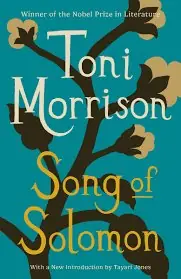
An insurance agent named Robert Smith steps off the roof of a Michigan hospital, trying to fly, and in the crowd below Ruth Dead goes into labor. Her son, Macon Dead III, becomes the first Black child born in that hospital, and picks up the nickname Milkman when Freddie, his father's janitor, sees his mother still nursing him long past infancy. He grows up in a prosperous, joyless house in Southside: his father Macon Jr. is greedy and hard, his mother passive, his sisters emotionally starved. The life in the family belongs to his aunt Pilate, a bootlegger and conjure woman who keeps her name in a box at her ear and a heavy sack hanging from her ceiling.
Milkman drifts into an affair with Pilate's granddaughter Hagar, tires of her, and sets off a devotion that turns murderous; each month she comes to kill him and each month fails to strike. When his father decides the sack in Pilate's house holds gold from a cave the two of them found as children, after white men murdered their father for his farm, Milkman and his friend Guitar steal it. It holds human bones. Milkman goes south anyway, first to the old family land in Pennsylvania and then, by accident, to Shalimar, Virginia, where children sing a song about Solomon, a slave who flew home to Africa and left a wife and twenty one children behind. It is the song Pilate sings, and it is his own family. Guitar, convinced Milkman has cheated him of the gold, follows him to Virginia and attacks him while he is out hunting.
Back home Hagar buys dresses and a haircut to win him and dies of grief. Milkman brings Pilate to Virginia to bury her father's bones, and at the grave Guitar's bullet, meant for Milkman, kills her. The last page has Milkman leaping toward his friend, and readers have argued ever since about what he learns in the air. The prose moves with what Kirkus called patient delicacy, darkly tense in one chapter and exuberant in the next, and the book is a fairly quick 337 pages. Best for readers who want a family quest with a folk song at the bottom of it.
Historical Context & Significance
Song of Solomon won the National Book Critics Circle Award for Fiction for 1977, presented in 1978, over John Cheever's Falconer, Joan Didion's A Book of Common Prayer, Philip Roth's The Professor of Desire and John Sayles's Union Dues. Reynolds Price, reviewing it for The New York Times, concluded that few Americans know, and can say, more than she has in this wise and spacious novel; Price would himself win the NBCC award nine years later for Kate Vaiden.
The book's standing has only risen. The Swedish Academy cited it when it gave Morrison the Nobel Prize in Literature in 1993, and Oprah Winfrey chose it for her book club. The Radcliffe Publishing Course put it at 25 on its 1998 list of the century's best English language novels, and Robert McCrum ranked it 89th in his 2015 Guardian list. Morrison returned to the NBCC list as a finalist for 1987 with Beloved, which lost to Roth's The Counterlife before taking the Pulitzer Prize the following spring. Vintage International keeps Song of Solomon in print with a foreword by the author.
Where to get it
We may earn a commission if you buy through these links, at no extra cost to you.
Opens WorldCat, a catalogue of library holdings run by the nonprofit OCLC. We do not ask for or receive your location.