Summary
In 1798 a small French force under General Humbert lands at Killala on the coast of County Mayo. The French expect to be the advance guard for Wolfe Tone and a larger expedition; the Irish who flock to them, Catholic tenants ground down by Protestant landlords and already organized in secret as Whiteboys, expect the year of their deliverance. Owen MacCarthy, a schoolmaster and poet, writes, at the Whiteboys' asking, the threatening letter to a landlord that they sign as the Whiteboys of Killala. For a few weeks the rebels win. Then Cornwallis brings the army west, the rising is broken at Ballinamuck, Killala is retaken, and the reckoning falls on the countryside, and on MacCarthy, who ends on the gallows.
Flanagan tells it through five narrators drawn from the factions of the day, with an omniscient author moving between them. Kirkus admired the infinite layering of motives this produces and the way minor figures get scenes of their own, and singled out MacCarthy as one of the few poets in novels who convinces as a poet. The action is compressed into a few months, which keeps a book of more than 500 pages from feeling grandiose, and the prose is rich in rhetoric and in landscape.
What reading it is like: demanding at first, because five voices must each establish themselves, then absorbing, and finally very bleak. Louis Menand in The New Yorker wrote that Flanagan's method is to plunge the reader into a strange, wild, poetic, cruel and finally hopeless world, and The Times of London called it a stark warning against romanticizing torrid times, which is right; nobody here is a hero for long. Best for readers of serious historical fiction who want Ireland's 1798 without the ballads, and who are prepared to give it the weeks it asks for.
Historical Context & Significance
The Year of the French won the National Book Critics Circle Award for Fiction for 1979 over five finalists: Philip Roth's The Ghost Writer, William Styron's Sophie's Choice, Norman Mailer's The Executioner's Song, Elizabeth Hardwick's Sleepless Nights and Leslie Epstein's King of the Jews. Mailer's book took the Pulitzer Prize that spring. Holt, Rinehart and Winston published the novel in May 1979. Its author was an American academic: born in Greenwich, Connecticut, in 1923, with all four grandparents from County Fermanagh, Flanagan taught English at Berkeley from 1960 to 1978 and then at Stony Brook, and his study The Irish Novelists 1800 to 1850 (1958) had made him an authority on the period.
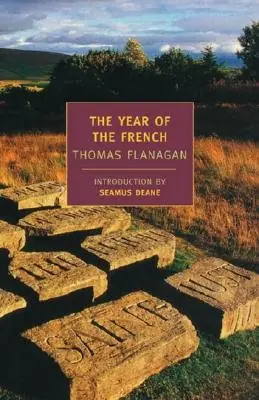
RTÉ, Channel 4 and FR3 filmed it as a serial directed by Michael Garvey, shot at Killala in 1981 and broadcast in November 1982, with music by Paddy Moloney and The Chieftains. The Tenants of Time (1988) and The End of the Hunt (1994) completed a trilogy on Irish rebellion. Flanagan died in Berkeley in 2002, aged 78. NYRB Classics reissued the novel in 2004 with an introduction by Seamus Deane.
Where to get it
We may earn a commission if you buy through these links, at no extra cost to you.
Opens WorldCat, a catalogue of library holdings run by the nonprofit OCLC. We do not ask for or receive your location.