Summary
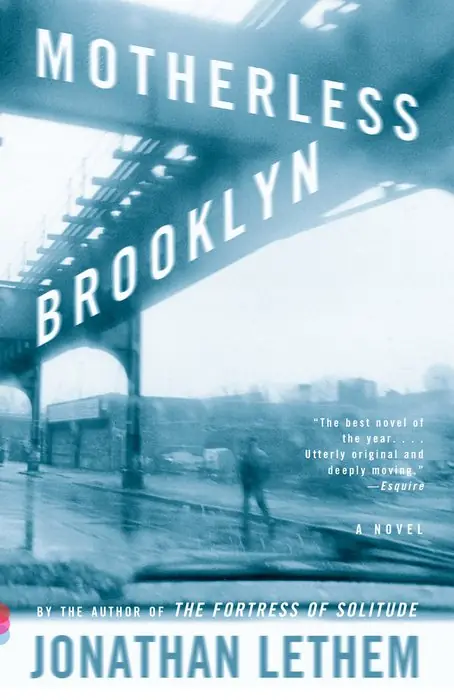
Lionel Essrog has Tourette's syndrome, and he narrates. Words come out of him doubled, rhymed, barked, and rearranged; he taps shoulders, straightens collars, and cannot leave a phrase alone, and Lethem makes the condition the engine of a detective novel rather than a quirk. Lionel was one of four teenagers Frank Minna pulled out of St. Vincent's Home for Boys in Brooklyn to move stolen goods and run errands, and as adults the four, Lionel, Tony, Danny, and Gilbert, are the Minna Men, staffing L&L, a car service that is really Frank's seedy and makeshift detective agency. On the first night of the book Frank is stabbed and dies, and Lionel, the one everyone calls Freakshow, decides to find out who did it.
The trail runs from Frank's widow Julia to a Manhattan Zen center where the Roshi turns out to be Gerard Minna, Frank's older brother; to the Fujisaki Corporation, the Japanese concern whose men pass through the Zendo as visiting monks; to a Polish giant who does the brothers' dirty work; and to Kimmery, a student at the Zendo who takes Lionel home, where he finds on her nightstand the pamphlet that points to Maine. The answer is a family one, what Publishers Weekly called a story of betrayal and lost innocence. Frank and Fujisaki's bookkeeper had been stealing from the corporation, and Gerard, to prove his loyalty to the Japanese, offered up his own brother; the giant did the killing. Lionel tails Tony and the giant to the Maine coast, where he finds Julia waiting tables at a Fujisaki restaurant fed by the sea urchin trade, learns the giant has killed Tony, wrecks the giant's car on a set of parking lot spikes, and ends a standoff with Julia by throwing both their guns into the sea. He gives Gerard's name to Frank's old mob clients, Gerard disappears, and Lionel goes back to L&L with Danny and Gilbert to make it the real detective agency Frank wanted.
The voice is the whole pleasure and it never flags: Kirkus called it a barrage of sheer rhetorical invention and Publishers Weekly a gonzo detective novel whose hero's compulsions turn out to be gifts for pattern finding. Albert Mobilio in the New York Times wrote that the book immerses us in the mind's dense thicket, a place where words split and twine in an ever deepening tangle. It is just over 300 pages, funny on nearly every one, and it suits readers of Chandler who are ready to be talked at by someone new.
Historical Context & Significance
Motherless Brooklyn won the National Book Critics Circle Award for Fiction for 1999, presented the following year, over A. Manette Ansay's Midnight Champagne, Frederick Busch's The Night Inspector, J. M. Coetzee's Disgrace, and David Gates's The Wonders of the Invisible World. It also won the Crime Writers' Association's Gold Dagger for 2000 and the Salon Book Award, and Esquire named it book of the year. It was Lethem's fifth novel; he was born in Brooklyn in 1964 and grew up in a commune in the Gowanus streets that became Boerum Hill, and the New York Times later said the book made him something of a hipster celebrity.
Edward Norton announced a film the year it came out and delivered it in 2019. His version, which he directed and starred in, kept Lionel, Frank Minna, and the murder and threw away the rest, moving the story to 1957 and building a new plot around a Robert Moses figure played by Alec Baldwin; it earned 18.6 million dollars on a 26 million dollar budget. Lethem followed the novel with The Fortress of Solitude in 2003 and received a MacArthur Fellowship in 2005.
Where to get it
We may earn a commission if you buy through these links, at no extra cost to you.
Opens WorldCat, a catalogue of library holdings run by the nonprofit OCLC. We do not ask for or receive your location.