Summary
Kyungha is a writer living alone near Seoul who cannot sleep and dreams, night after night, of black tree trunks standing in snow by the sea. A message comes from her friend Inseon, a documentary maker and woodworker who moved back to her mother's village on Jeju Island: she has cut off two fingers in her workshop and is in a Seoul hospital, and she needs Kyungha to go to Jeju at once to feed her pet bird, Ama, before it dies. Kyungha goes. A blizzard closes over the island, she loses the path to the village, falls into a dry stream bed and blacks out, and when she reaches the house the bird is already dead. She buries it. The power fails, and in the dark, unheated house Inseon appears, though she cannot be there, and begins to talk.
What Inseon tells is the story of her mother, who as a girl survived the massacres on Jeju in 1948 and 1949, when soldiers and police killed tens of thousands of islanders as suspected communists, and who spent her life searching for a brother taken away and killed. Han Kang builds the second half of the novel out of that testimony, the archives and photographs Inseon's mother collected, and the snow that falls on the present and the past alike. The ending will not settle: the two women sit out in the snow by the last of a candle, Kyungha no longer sure which of them is the apparition or whether she herself is dead, and the book closes on a struck match.
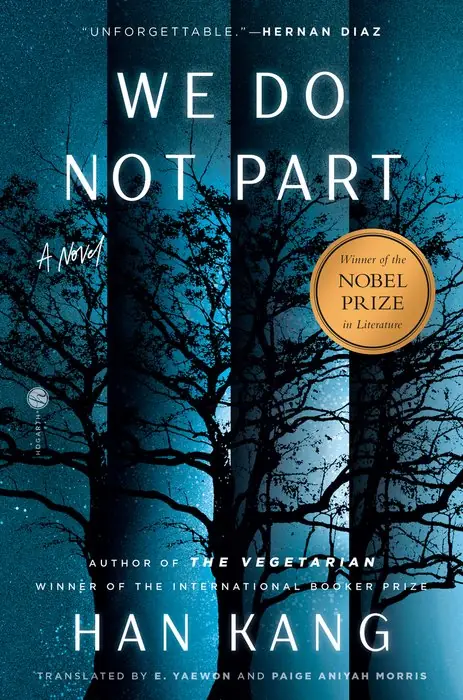
This is a short, slow, wintry book, translated from the Korean by e. yaewon and Paige Aniyah Morris, and Han has called it a pair with Human Acts, her novel of the Gwangju uprising. Kirkus praised "the quiet intricacy of the author's prose"; Publishers Weekly called the prose "dreamy yet devastating"; Leigh Haber in the Los Angeles Times found it "exquisite and profoundly disquieting" and offering no answers. It suits readers of Sebald and of Human Acts, and anyone willing to read a novel about an atrocity that approaches it through snow, a bird and a friendship.
Historical Context & Significance
We Do Not Part won the National Book Critics Circle Award for Fiction for 2025, presented on March 26, 2026 at the New School in New York. Fiction committee chair Heather Scott Partington called it "a work of blinding melancholy, bleak weather, and murmuring syntax," "a subtly rendered sketch of trauma in the wake of the Jeju Massacre and a rumination on creation and truth amidst loss." The finalists were Karen Russell's The Antidote, Katie Kitamura's Audition, Solvej Balle's On the Calculation of Volume (Book III), translated by Sophia Hersi Smith and Jennifer Russell, and Angela Flournoy's The Wilderness. The book was already garlanded: published in Korea by Munhakdongne in September 2021, it won the Prix Médicis étranger in 2023 in French translation, the first Korean book to do so, and the Prix Émile Guimet in 2024.
Between the French and English editions Han won the 2024 Nobel Prize in Literature, cited for "intense poetic prose that confronts historical traumas and exposes the fragility of human life." Hogarth published the English translation on January 21, 2025. Han, born in Gwangju in 1970, had won the International Booker Prize with The Vegetarian in 2016.
Where to get it
We may earn a commission if you buy through these links, at no extra cost to you.
Opens WorldCat, a catalogue of library holdings run by the nonprofit OCLC. We do not ask for or receive your location.